
No products in the cart.
Blog
How to Buy a VS Factory Watch: What to Check Before You Order
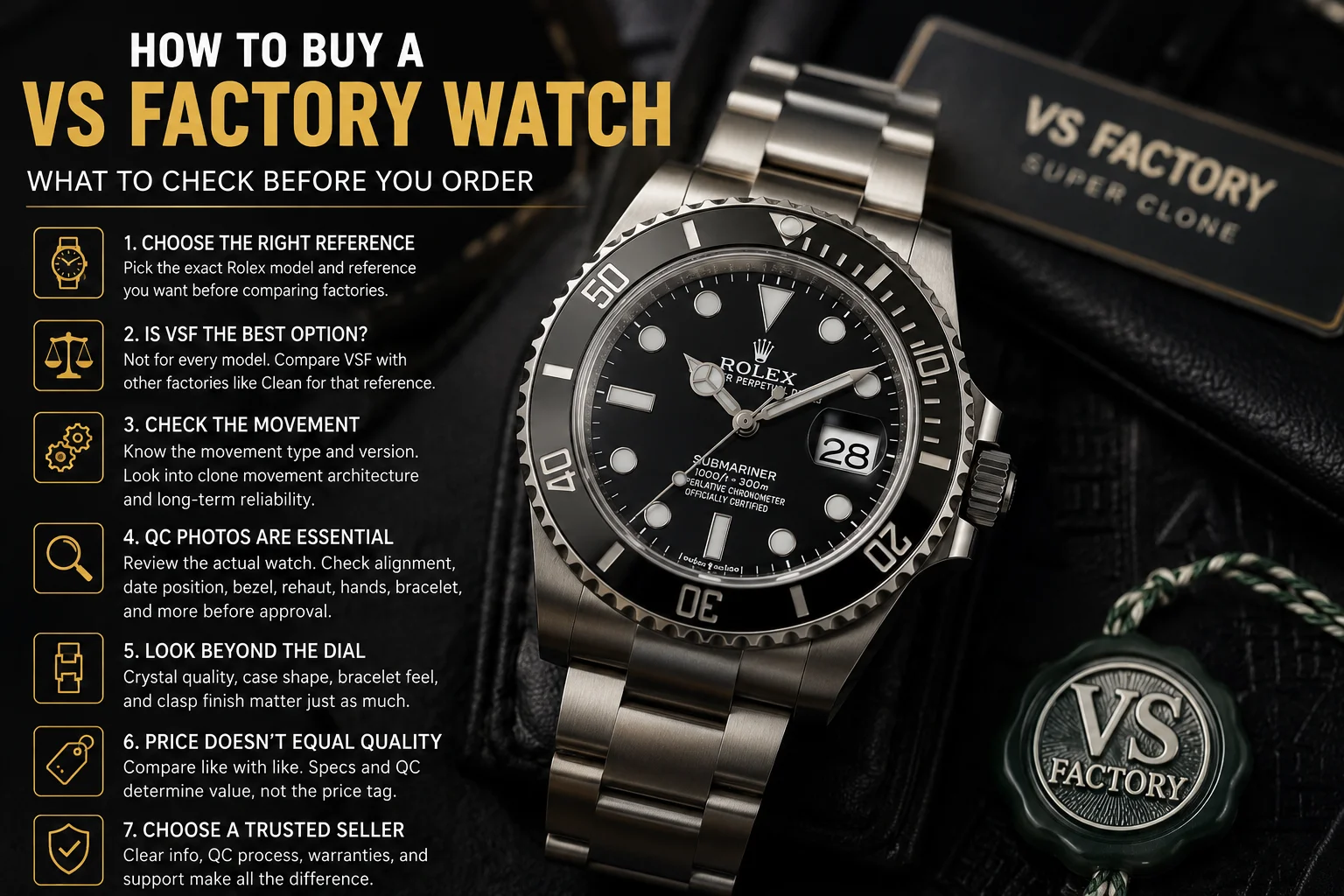
Buying a VS Factory watch looks easy right up until you start comparing listings. Then the mess shows up: multiple references, different movement versions, small spec changes, and sellers slapping “VSF” on the title as if that settles everything.
It doesn’t.
The smarter way to buy is simpler than the listings make it seem. Pick the exact watch first, check whether VS Factory is actually a strong choice for that reference, and look over the specific watch before you approve it. That keeps you from buying a label instead of a watch.
If you’re looking at a VSF piece, here’s what to sort out before you order.
Pick the Rolex reference before you think about factory names
Don’t begin with “I want a VSF.” Begin with the watch itself.
Something like Rolex Submariner 126610LN, Rolex Submariner 124060, Rolex Datejust 126334, or Rolex Datejust 126300 gives you a real starting point. That’s the level of detail you need, because factories don’t put out equally strong versions of every reference they touch.
VS Factory is closely tied to some Rolex-style super clone models, sure, but that reputation doesn’t automatically carry across every Submariner, Datejust, GMT, or anything else with the same badge in the listing. The reference decides the comparison, not the factory name by itself.
Once you’ve narrowed it down to the exact watch, you can compare VSF against the other factories making that same model. That’s a useful comparison.
If you want a broader look at the maker itself, the VSF Factory Watches guide goes deeper into the model range, movement options, and the details buyers tend to weigh.
Ask a narrower question: is VSF the best pick for this one watch?
A lot of buyers get stuck here. They read a few good comments about a VSF Submariner and then assume VS Factory must also be the obvious answer for every other Rolex reference.
That’s where people go wrong.
On some models, VSF and Clean Factory are compared constantly because each one has its own strengths. One version may have the crystal people prefer. Another may look better around the case shape or bezel. Then the movement changes the picture again.
So skip the broad question of whether VSF is “better” in general. It’s too vague to help.
The question that matters is much tighter:
Is VS Factory the strongest option for this exact reference?
Movement details shouldn’t be an afterthought
If the movement spec is buried in the product description, stop and find it. You need to know what you’re buying.
VS Factory gets a lot of attention partly because of the clone movements used in some references, and buyers compare more than the name on the movement. They look at crown action, date setting, power reserve, movement layout, and how closely the functions match the genuine watch.
Names get confusing fast.
Two watches from the same factory don’t automatically use the same movement generation, and assuming they do is an easy mistake. Confirm the movement for the specific reference in front of you, not for the brand or the factory in general.
If calibre matching matters to you, spend some time reading about calibre-matched clone movements before you treat factory reputation as the deciding factor.
And don’t assume the most complicated option is automatically the right one. Servicing and long-term reliability count too.
Don’t judge the watch from the dial alone
The dial gets all the attention because it photographs well. Real wear tells a different story.
Bracelet quality matters. Clasp feel matters. Case thickness matters. The way the lugs sit on the wrist matters. Crystal reflections matter too.
A sharp-looking dial won’t fix a watch that feels off every time you pick it up.
When you’re comparing a VS Factory piece against another version, step back and look at the whole watch instead of making the call based on one line of dial text at high zoom. Some of the differences you’ll care about most don’t show up until the watch is actually on your wrist.
Crystal quality is a good example. On Rolex-style models, the crystal affects dial clarity, reflections, and date magnification, so two watches with similar dials can still look noticeably different once light hits them.
Don’t just stare at straight-on photos. Angled shots usually tell you more, especially if you’re trying to judge reflections and how the dial reads through the crystal.
The bracelet deserves the same attention.
People obsess over the face of the watch, then end up noticing the bracelet every few minutes. That’s normal. It’s the part you keep touching.
A loose, rough, or badly articulated bracelet changes the feel of the whole piece. Check how the links sit together, how the clasp looks, and how brushed and polished surfaces meet. If there’s video, watch the bracelet move. Still photos don’t tell you everything here.
The line between a watch that only looks convincing and one that also feels convincing often shows up in these details first.
QC photos matter more than promotional shots
Factory photos show what the model is supposed to look like. QC photos show the watch you’re actually being sent.
That’s the difference.
Even two watches from the same factory can vary a bit in alignment or finishing, so don’t approve a watch based only on stock images.
Look over the usual trouble spots before it ships:
- Hour marker alignment
- Dial position
- Date centering
- Cyclops alignment
- Bezel alignment
- Rehaut positioning
- Hand alignment
- Bracelet and clasp condition
- Visible scratches or marks
You don’t need to inspect it like lab equipment. You’re just trying to catch obvious issues before the watch is on its way.
If you’re unsure what you’re looking at, the guide to reading QC photos before approval is a sensible place to start.
QC can get silly, though.
Blow up a photo far enough and tiny defects start looking dramatic. A slightly shifted letter or a minor marker variance may stand out at 500% zoom and disappear completely in normal wear.
That’s why one question cuts through a lot of nonsense:
Would you notice it without studying a magnified photo?
No replica watch is perfect, including ones from well-regarded factories. Small tolerances exist. Put your attention on the things that change the overall look instead of chasing mathematical perfection.
Price doesn’t tell you which version is better
More expensive doesn’t automatically mean better. Sometimes it just means different.
One version may cost more because of the movement, the material setup, or some other spec that matters a lot to one buyer and barely matters to another.
So compare like with like first:
Same reference.
Factory.
Movement.
Case.
Dial.
Crystal.
Bracelet.
QC quality.
After that, the price gap starts to make sense.
Without that comparison, the number alone tells you very little.
The seller matters too. Factory choice is only part of the purchase.
Before you pay, make sure the listing or seller can clearly explain the exact factory, movement specification, how QC works, shipping terms, return or replacement conditions, what happens if the watch arrives damaged, and what kind of communication you can expect after the sale.
Vague listings that say little more than “best 1:1 Rolex” aren’t giving you much useful information.
Also check the legal side where you live. Replica and counterfeit rules vary by jurisdiction, and that’s something to understand before ordering rather than after.
VSF vs Clean usually deserves a side-by-side check
If you’re shopping certain Rolex references, you’ll almost certainly run into the same comparison:
VSF or Clean Factory?
There’s no universal answer.
For a Submariner, buyers may care most about one set of details. For a Datejust, the decision may turn on the bezel, dial, bracelet, or movement. Change the reference again and the factory preference can shift with it.
That’s why a general ranking isn’t enough.
If both factories make the watch you want, compare those exact versions directly. A broader VSF vs Clean Factory comparison can help establish the differences before you narrow the decision down to the individual reference.
Don’t rely on reputation alone.
The shortest sensible buying process
This doesn’t need to be complicated. It just needs to be ordered properly.
Start with the watch you want.
Identify the exact reference.
Check whether VS Factory is one of the better options for that specific model.
Confirm the movement.
Compare it with the closest competing factory.
Review QC photos of the individual watch.
Then decide if the differences justify the asking price.
That’s it.
The main mistake is buying VSF because the listing says VSF. Buy the version that makes sense for the watch you’re actually trying to get.
Factory reputation can narrow the field, but the final call should come from the reference in front of you.