No products in the cart.
Official 1:1 Super Clone Category
Sea-Dweller
Rolex Sea-Dweller Super Clone Watches
From the front, a Sea-Dweller can pass as a larger Submariner. Turn it sideways and that idea starts to fall apart.
The case is taller. The bracelet has more mass to support. Crystal, bezel, and mid-case stack up on the wrist in a different way, and the whole watch feels denser and more deliberate before you even get to the helium escape valve or the model’s diving history.
That’s exactly why this reference is so easy to miss. A replica can have a convincing black dial and ceramic bezel and still feel wrong if the case is too blunt or the weight distribution is off.
The Sea-Dweller should look substantial.
It shouldn’t look awkward.
On this model, that gap matters more than one more line in a parts list.
The 126600 Comes Down to Proportion
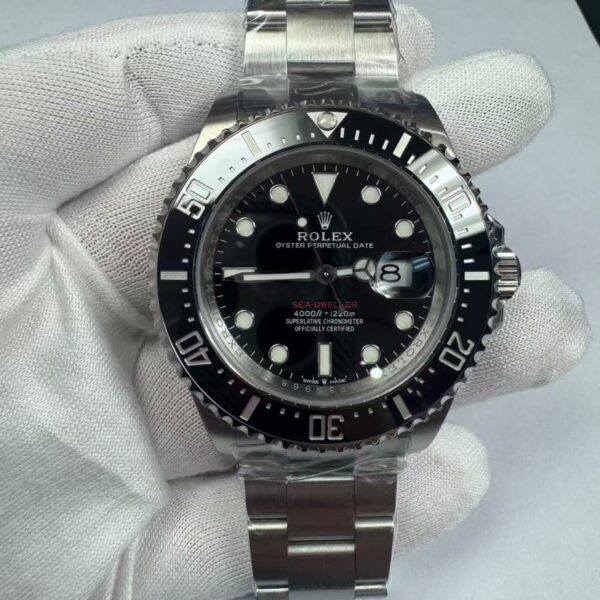
The current 126600 gives you the familiar basics: a 43mm case, black dial, black ceramic bezel, a date at three o’clock, and the red Sea-Dweller text that stands out right away on the modern version.
That’s the easy part.
The harder part is making all of those elements sit together the way they should.
A 43mm watch can look surprisingly balanced if the case shape, bezel width, and bracelet all agree with each other. Miss one of those and the watch starts looking bigger than its actual size, and not in a good way.
Side photos tell you a lot.
More than people admit.
Check the mid-case. See how high the crystal appears to rise. Look at the lugs from an angle instead of staring only at straight-on dial shots. Then watch how the first bracelet links leave the case.
You’ll learn more from that than from spending twenty minutes inspecting dial text.
Our current Sea-Dweller 126600 black-dial 43mm is the kind of reference I’d use for this because the design leaves nowhere to hide: black dial, black bezel, steel bracelet, no distractions.
The Helium Escape Valve Is a Small Detail That Changes the Whole Side Profile
Most people buying a Sea-Dweller will never need a helium escape valve for its original job.
Doesn’t matter.
It still affects the watch in a visible way.
On the genuine model, the valve is there for saturation diving. Helium can work its way into a watch while divers live under pressure, and the valve lets excess internal pressure out during decompression.
Interesting bit of engineering.
For replica buyers, though, the practical questions are simpler.
Is it placed correctly?
Does the left side of the case still look natural?
Is the finishing around it consistent with the rest of the watch?
A poorly positioned valve stands out fast once you’ve spotted the issue. A well-done one mostly disappears, which is exactly what you want.
I’d also ignore sellers throwing around giant depth-rating numbers as if a reproduction automatically shares the diving capability of the original.
It doesn’t.
The real Sea-Dweller was built as a professional dive watch. A replica should be trusted only to whatever pressure testing was actually done on that individual piece.
Those are not the same thing.
The Date Window Changes the Dial More Than the Red Text
The red Sea-Dweller line gets most of the attention.
I look at the date first.
On the 126600, the Cyclops makes that part of the dial impossible to hide. If the date sits too high, too low, or oddly inside the window, magnification doesn’t cover the mistake.
It puts it on display.
The crystal matters just as much. On a watch this thick, it can’t look like one more slab piled on top of an already tall case. The transition from bezel to crystal needs to look controlled and intentional.
Straight-down photos hide that.
Side angles don’t.
The bezel deserves the same kind of normal-distance check before you zoom all the way in. It should be broad enough to suit the case without swallowing the dial, and the numerals and graduations should read cleanly.
Still, the first thing I care about is the relationship between bezel, crystal, and case.
The Sea-Dweller already carries a lot of visual weight.
You don’t want one part yelling over the rest.
A Large Watch Still Needs to Wear Well
The Sea-Dweller isn’t trying to vanish under a cuff.
Obviously.
Still, there’s a difference between presence and a watch that keeps reminding you how heavy it is. Bracelet fit has a lot to do with that.
The Oyster bracelet needs to support a 43mm case without making the whole watch feel top-heavy. If the first links drop away awkwardly or the bracelet feels out of proportion to the head of the watch, you’ll notice the weight much more.
A proper fit spreads it out.
That’s the point.
The clasp matters too. The genuine Sea-Dweller uses Rolex’s Glidelock system, which lets you adjust the bracelet without tools. On a bigger watch, small fit changes make a bigger difference to comfort than they do on something thinner and lighter.
That’s worth thinking about before you buy.
People love comparing the Sea-Dweller and Submariner by diameter or movement specs, but wrist shape tells you more.
A flatter wrist can make a larger Sea-Dweller sit better than expected. A smaller or rounder wrist can make the same watch feel taller and less settled.
No spec sheet will tell you that.
You need to know what you actually enjoy wearing.
Sea-Dweller or Submariner?
This comes up every time.
From photos alone, the Submariner is the easier pick.
It’s familiar, easy to wear, and works for more wrists. There are also far more versions floating around, which makes shopping simpler.
The Sea-Dweller feels narrower in purpose, and that’s part of why people like it. It looks like a watch built around a job, not a design that gradually turned into a universal luxury sports model.
The extra diameter changes the feel.
The added case height changes it again.
The helium valve alters the side view.
Even the red text shifts the dial’s character a little without making it look flashy.
If you already like the Submariner and want the same basic formula with more presence, the Sea-Dweller makes sense.
If what you really want is just a slightly bigger Submariner, spend more time with side-profile photos before deciding.
They’re close relatives.
They do not wear the same way.
What I’d Check Before Picking One
I wouldn’t start with the factory name.
I wouldn’t start with movement codes either.
Start with the case.
That’s what defines this watch.
Does the 43mm shape look balanced?
Does the side profile feel heavy without looking crude?
Does the helium escape valve sit naturally in the case?
After that, look at the bezel and crystal together.
Then move to the dial and date.
Then the bracelet.
Only after the watch looks right would I spend time on the smaller technical debates that people drag out online for days.
The Sea-Dweller is a good reminder that accuracy isn’t always about tiny details.
Sometimes the biggest difference is visible from across the room.
One watch has the right stance.
Another doesn’t.
Better dial printing won’t fix that.
The Sea-Dweller Looks Best When the Design Doesn’t Overreach
That’s the simplest way to put it.
Black dial.
Black bezel.
Steel case.
Oyster bracelet.
A touch of red text.
There isn’t much decoration here.
Most of the personality comes from scale, shape, and construction.
That simplicity puts pressure on the case to be right. When the proportions are right, the Sea-Dweller has a purposeful look that’s hard to confuse with a dressier Rolex.
When they’re off, the first thing you notice is bulk.
Browse the Sea-Dweller models in our collection and compare the case profile, dial, bezel, and bracelet before getting distracted by factory labels.
If you’re still deciding which Rolex family suits you better, go back to the full Rolex super clone collection and compare the Sea-Dweller with the other Rolex models.
For this watch, I’d judge it from the outside in.
Case first.
Everything else later.
Important: Watches offered by SuperCloneReps are independent reproductions. They are not manufactured, sponsored, approved, or endorsed by Rolex SA and should not be represented or resold as authentic Rolex watches.