No products in the cart.
Official 1:1 Super Clone Category
Daytona
The Daytona is where replica-watch shopping gets complicated fast.
From a distance, the formula looks simple: three subdials, two pushers, a tachymeter bezel, and either an Oyster bracelet or a rubber strap. Nothing there sounds especially difficult to copy.
Put two Daytona replicas next to each other, though, and the gaps show up quickly. The subdials sit differently. One bezel looks too heavy. One crystal makes the dial seem darker. One bracelet feels noticeably better. Press the chronograph pushers and two watches that looked nearly identical in photographs can behave completely differently.
That last part deserves attention. A Daytona super clone is a mechanical chronograph, not just a picture of a Daytona. Movement construction and chronograph operation belong in the same discussion as the dial and case.
If you’re still learning how factories, movements, and production versions differ, start with our super clone watch buying guide before choosing the first Daytona with the right dial color.
Why the Daytona Gets Compared So Closely
There are a lot of visual reference points on a Daytona. The bezel carries printing all the way around it. The dial has three counters and several hands. The crown and pushers sit together on the side of the case, while the bracelet, clasp, and case profile add more places for small errors to appear.
Get one thing slightly wrong and most people won’t notice. Get five small things slightly wrong, and the entire watch starts looking different.
That is why Daytona comparisons become obsessive. It’s also why I wouldn’t judge one from a single front-facing factory photograph. A photograph can show the layout, but it leaves out the way the chronograph works, the way the bracelet bends, and the way the surfaces catch ordinary light.
Daytona 126500 Super Clone Watches
The newer Daytona generation changed enough small details that it deserves separate treatment from the previous 116500. The changes aren’t dramatic at first glance. That’s part of the difficulty.
Case shape, bezel treatment, dial proportions, and subdial surrounds work together. A replica can have the broad 126500 appearance and still feel closer to the previous generation once you look at the complete watch.
Start with the dial and bezel as one piece. Don’t immediately zoom into the Rolex coronet. Look at the counter size relative to the dial, the open space around each counter, and the way the bezel frames the case. If those larger proportions look natural, move on to the smaller details.
The complete arrangement tells you more than one isolated marking. A tidy coronet cannot rescue a case that has the wrong stance or a bezel that overwhelms the dial.
Daytona 116500 Super Clone Watches
The 116500 has been in the replica market much longer. Factories have had years to refine it, and buyers have had years to argue over every tiny difference.
White dial or black dial usually comes first. Then factory, crystal, bezel, and movement. Eventually somebody is comparing the shape of one letter at 500% zoom.
I would keep the order simpler. Start with the dial and subdial proportions, then examine the ceramic-style bezel and case. After that, operate the chronograph. The tiny printing details can wait.
The older generation has enough visual familiarity that broad errors stand out more than buyers expect. A watch can use familiar 116500 details and still look off because the dial is too crowded, the case is too thick, or the bezel doesn’t sit naturally around it.
White Dial vs Black Dial Daytona
The white dial creates a sharp contrast between the dial, subdials, and dark bezel. That makes the Panda-style configuration immediately recognizable, but it also exposes alignment differences. A ring that sits slightly unevenly or a marker that drifts from its expected position is easier to see against white.
The black dial feels visually tighter. Reflections behave differently, and small details don’t jump out with quite the same force.
Neither version is automatically more accurate. Pick the color you actually want to wear rather than the version a forum currently ranks a little higher. A theoretically stronger comparison is not much use if you dislike looking at it on your wrist.
Subdial Spacing Matters
Subdial spacing is one Daytona detail worth taking seriously. Chronograph movements determine where the counters can sit, so movement architecture and dial appearance are connected.
Older modified movements sometimes pushed the subdials into proportions that changed the whole face of the watch. The printing could be clean and the markers well placed, yet the watch still looked wrong because the counters sat too close together or too far from the edge.
Look at the complete arrangement. The empty space between the subdials matters nearly as much as the subdials themselves. Check the relationship between the counters, the hour markers, and the central hands before you start judging individual letters.
The Daytona Chronograph Should Actually Work
It sounds obvious. Still worth saying.
Don’t spend twenty minutes inspecting the dial and forget that you’re buying a chronograph. Start it, stop it, and reset it. Watch what the hands do.
The central chronograph seconds hand should operate normally when activated, and the counters should behave according to the movement fitted to the watch. The reset deserves its own check. The hands should return cleanly to their starting positions rather than stopping short or landing unevenly.
Then pay attention to the pushers. A button that feels clean and deliberate gives a very different impression from one that feels rough, sticky, or vague. You can’t see that in a factory photograph. A video or a proper QC check is far more useful here.
4130 Clone Movement
The 4130-style movement changed what buyers could expect from higher-end Daytona replicas. Older watches often compromised somewhere. The dial might look convincing while the movement underneath was completely different, or the movement architecture forced the subdials into visibly wrong positions.
Modern 4130-style clones made the Daytona more interesting mechanically, not merely visually. Still, a product title containing “4130” doesn’t make every watch equal.
Assembly matters. Regulation matters. Lubrication matters. So does the condition of the individual movement inside the watch. Two listings can use the same movement description and still leave you with different levels of adjustment or finishing.
If movement construction sits high on your list, read our 4130 clone movement guide before choosing a factory. The name gives you a starting point; the actual operation gives you more to work with.
4131-Style Movements in Newer Daytona Replicas
The newer Daytona generation introduced another movement discussion. Again, I wouldn’t buy a watch just because the listing contains a familiar caliber number.
Ask what the movement actually does. How does winding feel? Do the setting positions engage cleanly? Does the chronograph start and stop normally? Does everything reset where it should?
Those details matter far more after six months of ownership than whatever sounded impressive in the product description. A number on a listing is easy to copy. A clean sequence through winding, setting, timing, and reset is harder to fake in a QC video.
The Ceramic-Style Daytona Bezel
The Daytona bezel is impossible to ignore. It’s dark, glossy, and covered in a tachymeter scale, so it creates a strong border around the dial.
Look at the numerals and markings. Look at the way the surface catches light. Then step back and judge the complete watch.
The more useful question is whether the bezel looks proportionate to the case. A perfectly executed “240” marking won’t help if the entire bezel is too thick. Buyers sometimes spend ten minutes studying one number and barely look at the shape of the watch around it.
Check the scale, but don’t let one attractive close-up make the whole decision for you.
Panda Daytona Super Clone Watches
The white-dial Daytona with dark subdial surrounds is probably the most recognizable modern Daytona configuration. It’s also one of the easiest to compare because the contrast is so strong.
That helps with alignment and exposes small differences at the same time. Look at the subdial rings, marker placement, and hand alignment. Then look at the white dial itself.
Studio lighting can make a slightly warm dial appear bright white. A single product photograph is never the whole story, especially with a Panda Daytona. Compare the dial under more than one lighting condition if the seller provides those images or video.
Gold Daytona Super Clone Watches
Gold-tone Daytona replicas add another variable immediately: color.
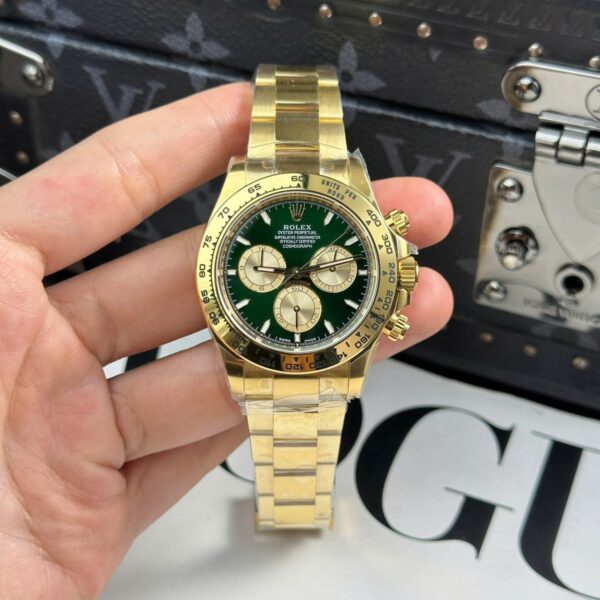
You can have a good dial, a sound movement, and a clean bezel, then end up with a watch that feels wrong because the case and bracelet tone is too yellow or too pink. The parts need to agree with each other.
Compare the case with the bracelet. Look at the crown and pushers. The watch should look as if those parts belong together rather than having been assembled from different color references.
Bright photography makes polished gold-tone surfaces look spectacular. Normal daylight tells you much more. It reveals whether the color feels balanced and whether the finishing changes awkwardly from the case to the bracelet.
Yellow Gold, Rose Gold and White-Metal Daytona Models
Each metal treatment changes the watch significantly. Yellow gold is the loudest traditional configuration. Rose-gold tones bring more warmth and work especially well with chocolate, black, and sundust-style dials. White-metal versions are quieter and can look surprisingly close to steel from a distance.
With colored-metal replicas, I would give case finishing and bracelet tone more attention than microscopic differences in dial printing. You see the metal from every angle. A small printing flaw can disappear at arm’s length; an uneven tone follows the watch around your wrist.
Daytona on Rubber Strap
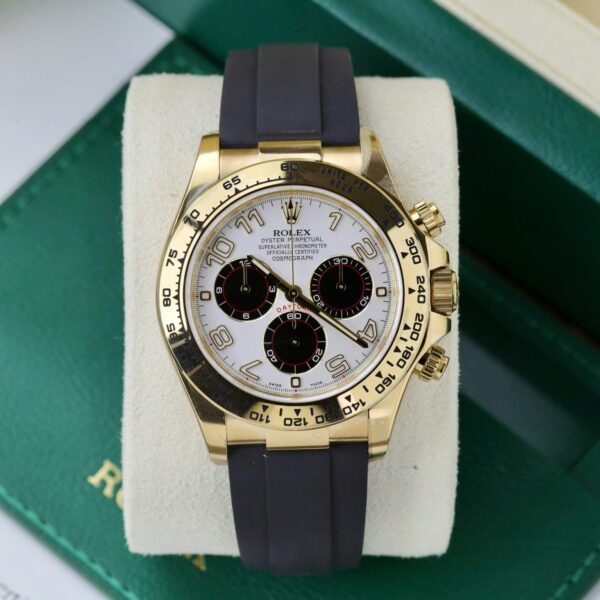
A Daytona on an Oysterflex-style rubber strap wears differently from one on a full metal bracelet. The watch head remains substantial, but you lose much of the bracelet’s weight and articulation.
That makes strap fit important. A stiff rubber strap can make the watch sit higher than it should or pull awkwardly against the wrist. Look at how it connects to the case, check the clasp, and watch how naturally the strap curves.
Rubber is simpler than a multi-link bracelet, but simple construction doesn’t guarantee a comfortable result. The connection at the lugs and the shape around the wrist do most of the work.
The Oyster Bracelet Still Matters
People buy the Daytona for the dial. They live with the bracelet.
Every time you put the watch on, you use the clasp. Every time your wrist moves, the bracelet moves with it. If the edges are sharp or the links feel loose, you’ll notice that far more often than slightly imperfect dial printing.
Check articulation, finishing, end-link fit, and clasp operation. Look for a bracelet that follows the wrist rather than sitting like a rigid strip beneath the case. A bracelet becomes more noticeable after the excitement of buying the watch has worn off, which is exactly why it deserves more than a quick glance in the listing photos.
Weight on Precious-Metal Daytona Replicas
Weight becomes more noticeable once you move beyond steel. A gold-colored Daytona creates a certain expectation when you pick it up. If a substantial precious-metal-style watch feels unexpectedly light, your brain notices the contradiction.
The heaviest replica doesn’t automatically win. Balance still matters. A very heavy watch head attached to a light bracelet can feel strange, while a slightly lighter piece with better distribution can sit more naturally.
Look for believable weight distribution rather than the biggest number on a scale. The case, bracelet, clasp, and movement all contribute to how the watch feels in use.
Meteorite, Turquoise and Special Daytona Dials
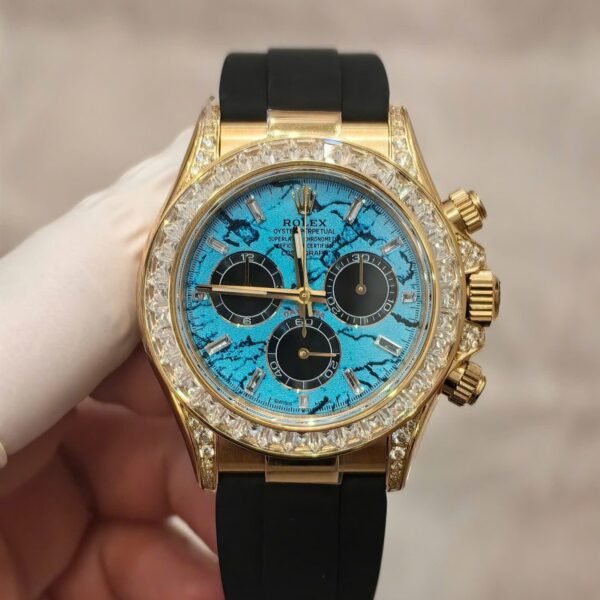
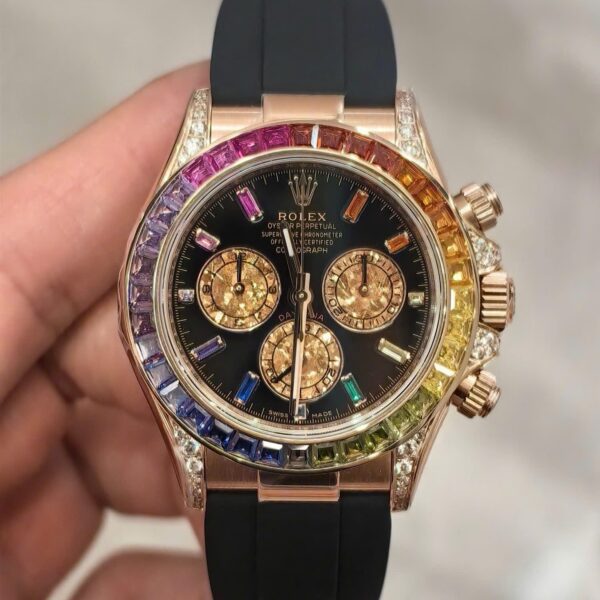
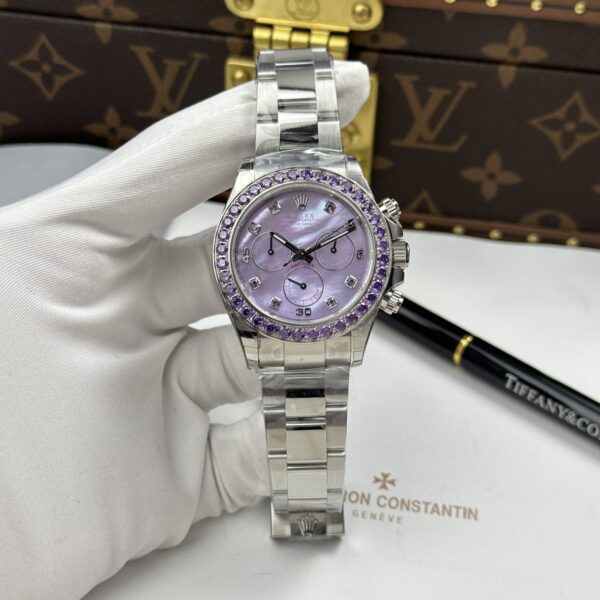
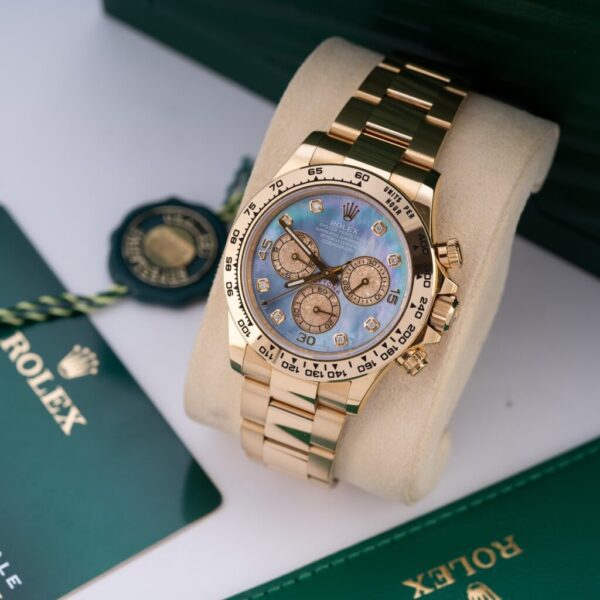
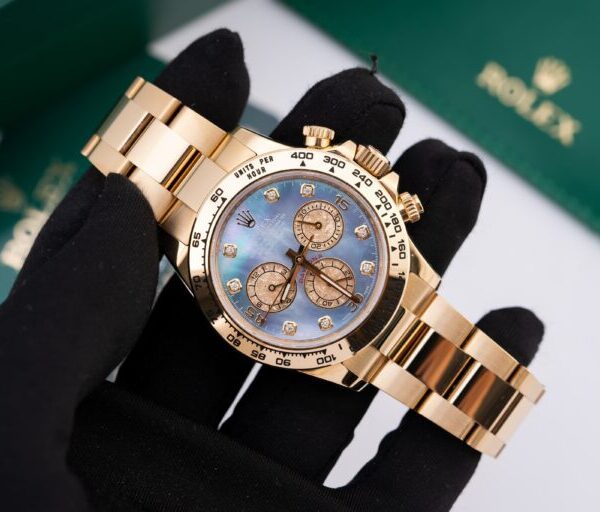
The Daytona catalog gets complicated once you move away from standard black and white. Meteorite-style dials, mother-of-pearl, turquoise, Le Mans-inspired versions, rainbow configurations, diamond markers, and custom moissanite builds all appear in the market.
Some attempt to reproduce known references closely. Others are customized pieces built around the Daytona platform. A custom Daytona should be judged as a custom watch rather than criticized because Rolex never sold that exact combination.
Just know what you’re buying. The visual target changes with a custom build, so the questions shift toward dial texture, stone work, color consistency, and the quality of the base watch.
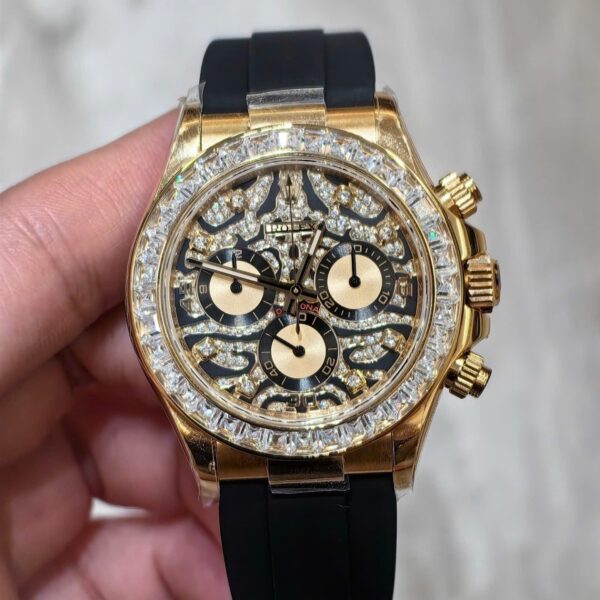
Diamond and Moissanite Daytona Watches
Once stones are added, inspect the base watch first. Ignore the sparkle for a minute.
Does the chronograph work? Does the dial sit correctly? Does the bezel look straight? Does the bracelet or strap feel right?
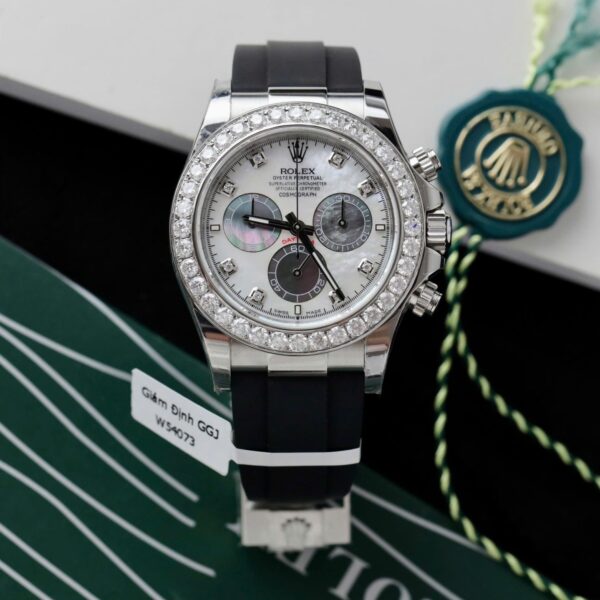
Then inspect the setting. Check spacing and rows. Look for stones sitting noticeably higher or lower than the ones beside them. Uneven gaps and wandering rows are easier to spot once the light stops doing all the work.
Bright lights can make almost anything sparkle. Clean setting is harder to hide. The stone work should support the watch rather than distract you from a poorly aligned dial or a chronograph that doesn’t reset properly.
Which Factory Makes the Best Daytona?
This is one of the most argued-about questions in the replica-watch hobby. There is no permanent answer I would use blindly.
Different factories prioritize different areas. One may have a dial buyers prefer. Another may offer a stronger bracelet or case. A third may make more sense for a particular precious-metal or weighted version. Production revisions change the comparison too.
A factory comparison only means something if you know which version of each watch is being discussed. A name that led the conversation last year may not describe the same production version today.
Our Daytona factory comparison goes deeper into the major options without pretending one factory permanently wins every reference. Use factory reputation to narrow the choice, then inspect the actual watch.
Clean Factory Daytona
Clean is one of the names buyers repeatedly encounter while researching Daytona replicas. That reputation gives you a useful starting point. It shouldn’t end the comparison.
Check the reference, dial configuration, movement, and production version you’re actually ordering. Then look at QC. A respected factory can still produce an individual watch with an alignment, cosmetic, or mechanical issue.
The listing name tells you where the watch came from. It doesn’t replace the inspection of the specific piece being shipped.
BTF, QF, VSF and Other Daytona Factories
The Daytona market is no longer a one-factory conversation, which is probably good for buyers. Competition gives factories a reason to keep improving cases, crystals, bracelets, movements, and weighted versions.
It also makes comparisons messier. Don’t choose BTF, QF, VSF, Clean, or another factory simply because someone wrote “best” beside its name. Choose the version that fits the specific Daytona you want.
The factory name isn’t what ends up on your wrist. The individual watch does.
What We Check During Daytona QC
The Daytona needs a different QC routine from a simple three-hand watch. Start with the complete dial. Look at the subdials and markers, then check whether the central chronograph hand sits naturally at rest.
Move to the bezel and overall case alignment. After that, operate the watch: start the chronograph, stop it, and reset it. Check the crown and pushers rather than assuming they work because the photographs look clean.
Inspect the case, bracelet or rubber strap, and clasp afterward. Movement timing can be checked separately where testing is available.
Our Rolex super clone QC process explains how the individual watch is reviewed before dispatch instead of assuming every piece leaving a known factory will be identical.
Watch the QC Video
On a Daytona, video shows more than it does on many watches. A photo tells you how the dial looks. It can’t show the chronograph resetting, the feel of the pushers, or the way the bracelet moves.
Video also shows how a sunburst or meteorite-style dial changes as the watch rotates. If video is available, use it. Let the watch move before judging a surface that was photographed under controlled lighting.
Do Not QC a Daytona Like a Microscope Slide
Daytona buyers are particularly good at overdoing this. The dial has so many details that there’s always another feature to enlarge. Eventually every watch starts looking defective.
Take a normal look first. Does anything immediately bother you? Are the subdials visibly strange? Does the bezel sit naturally? Does the chronograph reset properly? Does the bracelet fit correctly?
Those are useful questions. Whether one letter looks fractionally thicker after ten minutes of extreme magnification usually isn’t. You’re going to wear the watch at arm’s length, not examine it under a laboratory microscope.
Which Daytona Super Clone Should You Choose?
Start with the generation. Do you prefer the 116500-style look or the newer 126500 design?
Then pick the dial. White and black are the obvious choices, but gold, chocolate, meteorite-style, turquoise, and custom configurations open up more options once you start exploring. Decide between a bracelet and rubber strap where appropriate.
Only then compare factories and movements. This order makes more sense than deciding you absolutely need one factory and trying to convince yourself to like whichever Daytona that factory happens to make.
Explore Rolex Daytona Super Clone Watches
Browse our Daytona collection to compare 116500, 126500, Panda, black-dial, gold-tone, rubber-strap, and custom configurations across different factories and chronograph movements.
The Daytona isn’t a watch I would buy from photographs alone. There are simply too many moving parts. Literally.
A strong one needs the dial, case, bezel, movement, and bracelet or strap to work together. That matters more than winning an argument about one microscopic detail.
Important: Watches offered by SuperCloneReps are independent reproductions. They are not manufactured, sponsored, approved, or endorsed by Rolex SA and should never be represented or resold as authentic Rolex watches.
-
 Rolex Super Clone
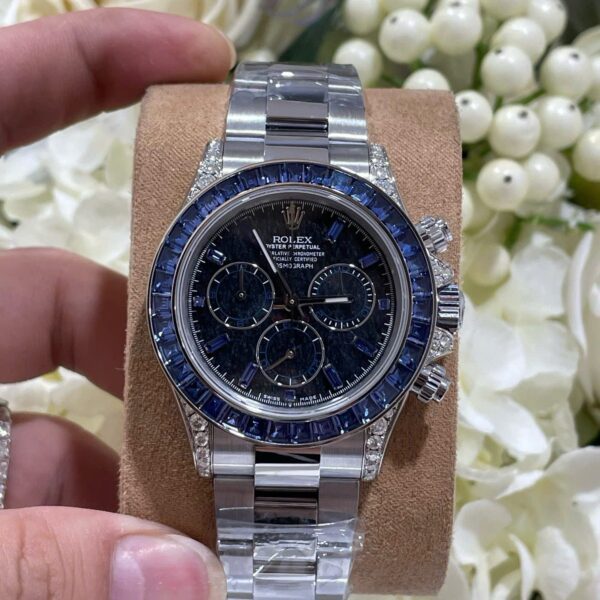
Rolex Daytona 126599TSA 18K Gold Wrapped Synthetic Blue Sapphire Custom 40mm
$2,000.00 -
-
Rolex Super Clone
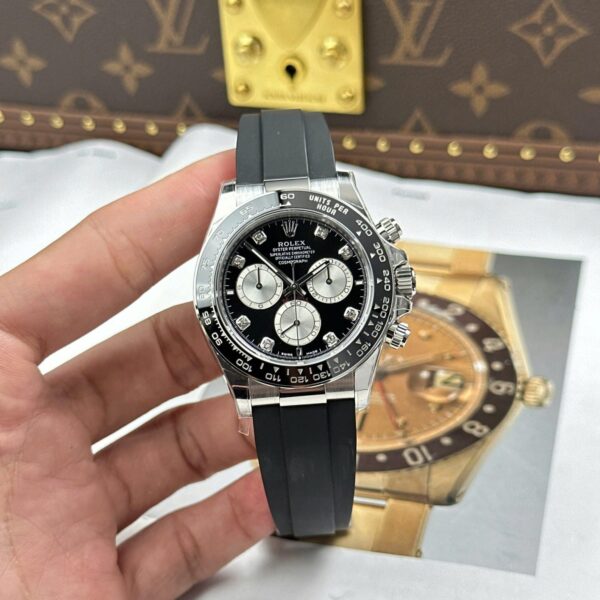
Rolex Cosmograph Daytona 126519LN Black Dial Oysterflex Strap Clean Factory 40mm
$1,400.00 -
-
-
-
-
-
Rolex Super Clone
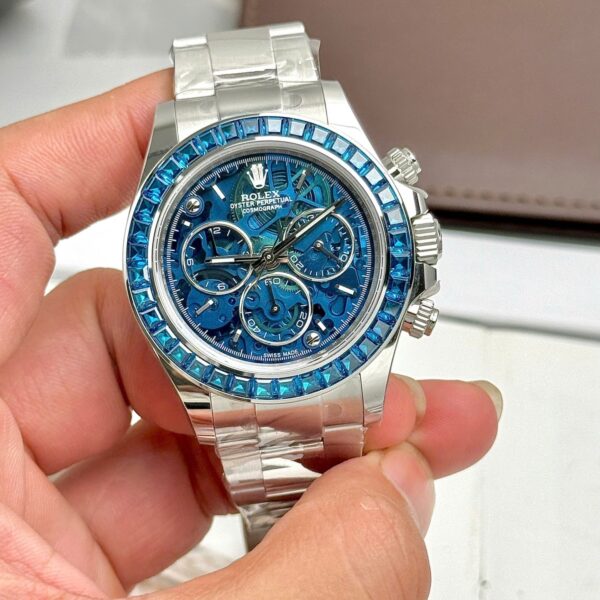
Rolex Daytona MOP Dial Number Pile Bezel Diamonds Moissanite Custom 40mm
$1,400.00 -
-
-

-
Rolex Super Clone
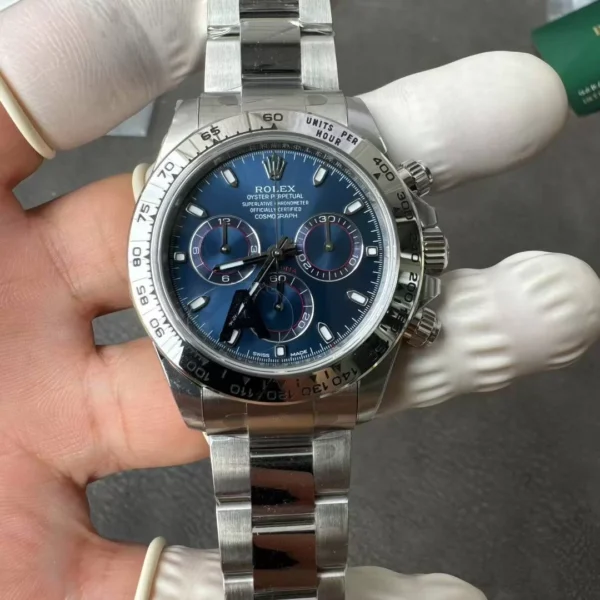
Rolex Cosmograph Daytona White Gold Blue Dial 116509 1:1 Super Clone DD4130 Movement
$1,600.00 -
Rolex Super Clone
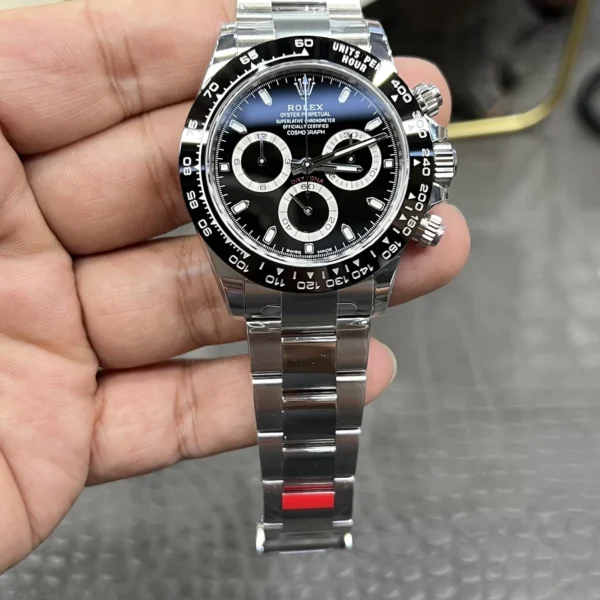
Rolex Cosmograph Daytona Black Dial Black Ceramic Bezel 40mm 116500LN 1:1 Super Clone DD4130 Movement
$1,600.00 -
Rolex Super Clone
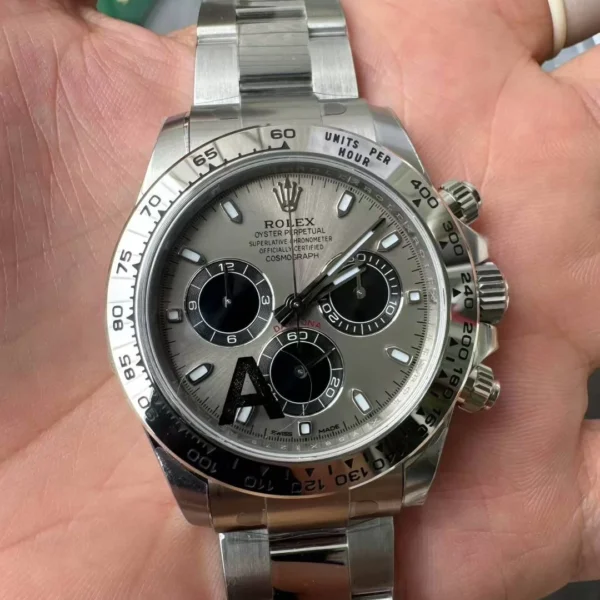
Rolex Cosmograph Daytona White Gold Slate Grey Dial 116509 1:1 Super Clone DD4130 Movement
$1,600.00 -
Rolex Super Clone
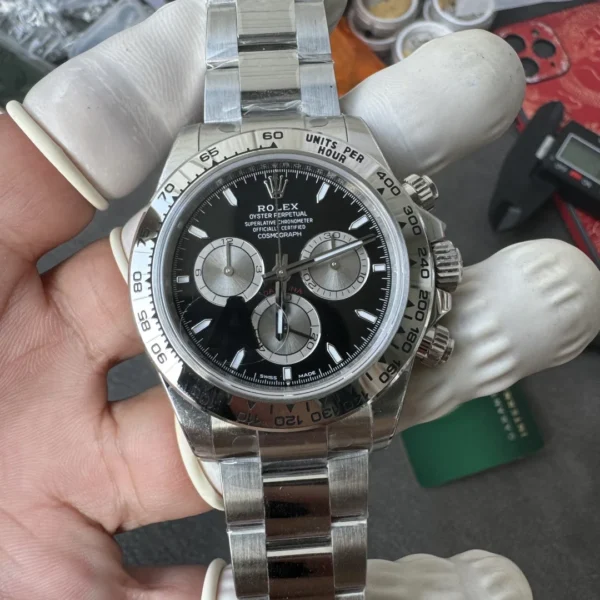
Rolex Cosmograph Daytona 40mm Black Dial White Gold (126509) 1:1 Super Clone – DD4131 Movement
$1,600.00