No products in the cart.
Official 1:1 Super Clone Category
DeepSea
The Deepsea makes sense beside a regular Submariner because every part has been turned up. The case is larger, the watch sits higher, and the bezel carries more visual weight. The bracelet has more work to do with all that case above it. Even the dial seems deeper because of the structure around it.
That is why Rolex Deepsea super clone watches need a different kind of inspection from the rest of the Rolex dive-watch lineup. A Submariner comparison might begin with the bezel, date window, dial, and bracelet. Those details still matter here, but the first question is simpler: does the complete watch look believable at this size?
If the answer is no, perfect dial printing won’t rescue it. A convincing Deepsea has to read as one object, not a collection of decent parts.
The Deepsea Has to Feel Like One Watch
The common mistake is judging each component in isolation. A thick case seems right. A large bezel seems right. A high crystal, heavy caseback, and substantial bracelet all belong on the model. The trouble starts when their proportions disagree.
A case might be too tall through the middle while the caseback stays relatively flat. Another can have a believable profile but a bezel that makes the dial opening look oddly small. Sometimes the watch head looks fine until the bracelet begins; the first links then appear too narrow for everything sitting above them.
One straight-on photograph won’t show that relationship. Start with the complete shape, then check how the parts meet. The Deepsea should look heavy by design, not like a smaller watch with extra material attached.
116660, 126660 and 136660 Are Not the Same Deepsea
The 116660 is the older generation many buyers recognize immediately. The 126660 changed the proportions and updated other parts of the watch, while the 136660 continued that development. They share the Deepsea identity, but they shouldn’t be compared as interchangeable versions.
Case dimensions and bracelet proportions shift between references. Movement generations change too, and certain dial and bezel details move with them. A listing that treats all three as one generic Deepsea leaves out the information needed for a useful comparison.
Choose the reference before choosing a factory. That sounds obvious until several listings place different generations in the same conversation. A case that looks appropriate for a 116660 may look wrong beside the details expected on a 126660 or 136660.
Black Dial or D-Blue?
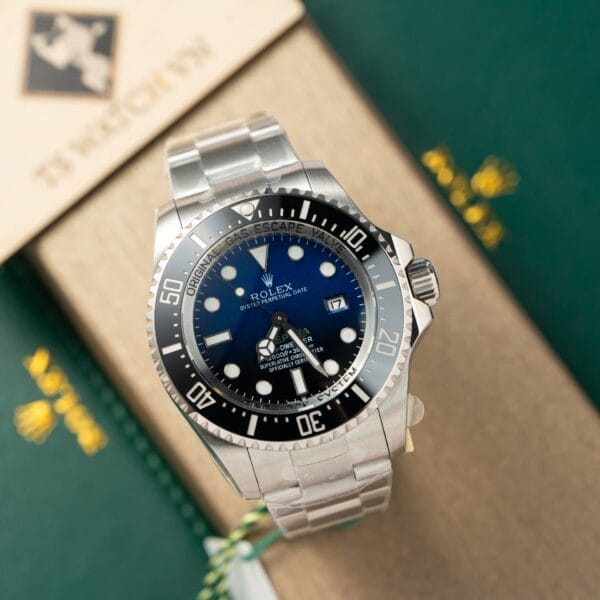
For many buyers, the dial is the first real choice. The black version keeps the watch relatively restrained, at least by Deepsea standards. D-Blue is more demanding because the blue-to-black transition varies noticeably from one batch to another.
A photograph can make a mediocre gradient look excellent. Strong lighting pulls out the blue. Dark lighting hides an uneven transition, and heavy editing can make the color appear deeper than it is. One bright image tells you very little.
Ask for several views: straight on, from an angle, and under softer lighting if possible. The question isn’t whether the dial is blue enough. Look at whether the transition remains natural across the surface, without a hard band or a washed-out center.
Black is easier to read at a glance, but it places more attention on the case, bezel, crystal, and bracelet. D-Blue draws the eye toward the dial first. Neither version excuses weak proportions elsewhere.
The Dial Can Be Good and the Watch Can Still Look Wrong
Large watches expose proportion mistakes. A buyer may zoom into the text, inspect every marker, and check the date until everything appears tidy. Pull back to a normal viewing distance and the whole watch still feels off.
The surrounding structure is usually responsible. There is a lot between the edge of the dial and the outside of the case: the visible inner structure, crystal, bezel, and the case architecture itself. All of it affects how large the dial appears. A dial that looks normal by itself can seem undersized inside an oversized front assembly.
Use both close-up and normal-distance photographs during QC. A macro image shows a crooked marker or uneven printing. A normal shot tells you whether the watch works as a complete object. You need both views, and neither should be treated as a substitute for the other.
The Inner Ring Is Part of the Deepsea Look
The structure around the dial is one of the details that separates the Deepsea visually from simpler Rolex dive watches. It should sit evenly around the dial, with consistent spacing and printing that doesn’t look squeezed into a narrow gap.
Check how that inner area relates to the crystal and bezel. It should feel built into the front of the case, not like a separate ring dropped into it. This isn’t usually the first thing someone notices across a room, but it becomes obvious during a side-by-side comparison.
A good inner ring supports the Deepsea’s layered appearance. A poorly sized one makes the dial opening, bezel, and crystal seem disconnected.
The D-Blue Dial Needs Normal Lighting
Factory photography is particularly unreliable with D-Blue. Under strong lights, the blue becomes brighter, the black section becomes deeper, and the transition appears more dramatic than it may look indoors.
That change in appearance doesn’t automatically make the dial wrong. It shows why color needs context. Ask to see the same watch in ordinary indoor lighting rather than judging from the brightest image in the listing.
For a D-Blue Rolex Deepsea super clone, compare the color across several photographs. Watch for a gradient that disappears into black too abruptly or turns into a bright strip under direct light. The green text on versions that use it deserves the same treatment. It should sit within the dial design instead of calling attention to the photographer’s processing.
Bezel Proportion Comes Before Bezel Printing
Deepsea bezels invite too much close-up analysis. Someone zooms into one numeral, decides the engraving looks good, and treats that small detail as a verdict on the entire watch. Start somewhere else.
Look at the complete bezel. Does its width make sense against the dial? Does it sit naturally against the case? Is the insert centered and even? Does the bezel look heavy in the way a Deepsea should, or merely oversized?
Only after the overall shape works should you inspect the engraving. Check the numerals, filled markings, and any obvious inconsistencies. A clean photograph of one section cannot compensate for a bezel that makes the dial opening look wrong.
The Crystal Changes the Whole Front of the Watch
The crystal has an outsized visual role because of the Deepsea’s upper case structure. View it from the side. If it sits too high, the watch looks taller than it already is. If it sits too low, its relationship with the bezel changes. A straight-on image may hide either problem.
Then look through the crystal at an angle. The dial should stay clear rather than turning hazy under glare. Check how the date appears through the Cyclops, and see whether glare flattens a black dial or washes out the D-Blue transition.
The crystal is part of the visible architecture here. Treating it as a transparent cover misses how much it changes the front profile.
Case Thickness Needs Context
A Deepsea should be thick. Thicker alone isn’t a quality standard.
Look at where the height comes from: the mid-case, bezel, crystal, and caseback all contribute. If nearly all the extra height appears concentrated in one area, the profile starts to look awkward. The watch should read as one continuous shape, not a thick middle with a watch attached above and below it.
Side photographs are especially useful here. A front image can make a large case seem convincing while hiding a crystal that sits too high or a caseback that adds an unexplained bulge.
The Caseback Can Change How the Watch Wears
The underside rarely gets much attention in a product listing, yet it changes where the watch sits on the wrist. A large caseback adds height underneath. Too much protrusion can make an already tall watch feel even taller.
It also affects stability. A heavy watch head resting on a relatively narrow contact point can shift around more than expected. The issue isn’t simply comfort; movement changes the way the case, bracelet, and wrist relate to one another.
One useful side photograph tells you more here than another perfectly lit dial shot. Look for the caseback shape, the angle of the lugs, and the point at which the bracelet leaves the case.
The Bracelet Has to Control a Heavy Watch
The Deepsea puts more demand on its bracelet than a lighter Rolex-style watch. A bracelet that looks acceptable on a smaller case can seem inadequate once it has to support this much metal.
Start with the end links. They should meet the case cleanly, without an obvious gap or a narrowed transition. Then inspect the first few links. Do they articulate naturally? Does the bracelet drop away from the case, or does it stay stiff and make the watch head sit proud?
The clasp belongs in the same inspection. A large dive watch needs a clasp that looks proportionate to everything attached to it. A thin or loose-feeling clasp can become the weak point even if the case itself is well made. The bracelet should look capable of carrying the watch, not like an afterthought.
Deepsea Weight Is Not a Competition
Buyers expect a Deepsea to feel heavy, which makes weight numbers an easy selling point. The largest number still isn’t automatically the better option.
Distribution changes the experience. A very heavy case attached to a comparatively light bracelet can feel top-heavy. A slightly lighter watch with better balance may seem more convincing once it sits on the wrist. A gram figure tells you how much material is there; it doesn’t tell you where that material sits.
Use weight as one reference alongside the case profile, bracelet, and caseback. Don’t let it become the whole argument.
The Helium Escape Valve Is Easy to Overthink
The helium escape valve is part of the Deepsea identity, but most owners won’t use it. For replica inspection, the practical question is visual: does it sit correctly in the side of the case, look cleanly integrated, and avoid an odd protrusion?
A valve-shaped component is not evidence that the watch has the same engineering or pressure capability as the original. Appearance and function are separate claims. For most buyers, a clean side profile is the useful part of this inspection.
Water Resistance Needs a Real Number
The genuine Deepsea is known for extreme depth capability, so water-resistance claims deserve more scrutiny here than on many other replicas. A listing shouldn’t simply copy the original model’s number.
A replica can have a screw-down crown, a helium-valve appearance, a dive bezel, a thick crystal, and a substantial case without being pressure tested anywhere near the genuine specification. If a specific watch has been tested, use that result. If it hasn’t, don’t assume one.
The appearance of an extreme dive watch and its actual pressure rating are different claims. A watch can look the part without being suitable for extreme depth.
The Date Is Small but Very Visible
The Deepsea dial is relatively uncluttered, which gives the date more attention than its size suggests. Check its centering, then look at several dates if photographs allow it. A single-digit date may appear centered while a double-digit number sits noticeably to one side.
The Cyclops needs to line up with the date as well. Because the watch is already large, it’s tempting to dismiss these smaller details. They remain visible precisely because there isn’t much else competing with them on the dial.
Movement Matters After the Watch Looks Right
The movement discussion is simpler here than it is with a Daytona or GMT-Master II. There is no chronograph and no independent GMT hand. Wind the watch, set the time, set the date, and check the crown positions. Watch how smoothly the hands move during setting. Check power reserve if that feature matters to you.
Different generations and factories may use different movement types, so the movement description still belongs in the comparison. A familiar caliber number, however, shouldn’t end the inspection. A movement can be good while the case is wrong. The case is what you wear.
Black Deepsea Versions Put More Pressure on the Case
D-Blue naturally pulls attention toward the dial. The black version removes that distraction, so case, bezel, bracelet, and crystal proportions carry more of the visual load.
That can make black easier to judge in one respect. Look at the complete outline first: the apparent width of the bezel, the height of the case, and the way the case meets the bracelet. Then move to the smaller details.
A simple color scheme doesn’t make the replica easier to build. It changes where mistakes become visible.
Factory Names Should Narrow the Search
Several factories may produce Deepsea versions, and their strengths can differ. One may get the case shape closer. Another may offer a D-Blue dial that buyers prefer. A third may have a movement or bracelet configuration that fits a particular reference more sensibly.
So the question of which factory makes the best Deepsea is incomplete without the reference and configuration. Start with the generation, then choose the dial. Compare the movement and factory version after that, and inspect the actual piece rather than stopping at the factory label.
A factory name can narrow the search. It cannot perform QC on the individual watch.
What to Look for During Deepsea QC
Begin at normal viewing distance. Does the case look balanced? Is the bracelet substantial enough for the watch head? Does the bezel make sense against the dial? If it is D-Blue, does the gradient remain natural outside the bright listing light?
Move closer only after the overall outline works. Check the dial, date, Cyclops, bezel insert, engraving, inner ring, crystal, and crown. The order is deliberate. There is little value in finding a microscopic printing flaw before noticing that the whole watch looks too tall.
Then turn the watch sideways. One side photograph can reveal case thickness, crystal height, bezel position, caseback shape, and bracelet angle at once. Finish by checking the movement functions and crown positions.
Don’t Turn Deepsea QC Into a Thickness Contest
The Deepsea is thick. Everyone knows that. Buyers sometimes make the opposite mistake and assume the largest or heaviest replica must be the better one.
The goal is the right relationship between size, shape, weight, and bracelet. A watch can be large and balanced. It can also match the stated diameter and thickness while feeling clumsy because those dimensions are distributed badly.
Numbers help establish a starting point. Photographs show how those numbers became an actual watch.
Which Rolex Deepsea Super Clone Should You Choose?
Choose the generation first: 116660, 126660, or 136660. Then decide between black and D-Blue. Compare the case profile, bezel, bracelet, crystal, movement, and factory version in that order.
Choosing a factory first leaves you trying to justify whichever Deepsea configuration happens to be available from it. The model is too distinctive for that shortcut. Reference and dial choice should set the direction before the factory enters the discussion.
Explore Rolex Deepsea Super Clone Watches
Our Rolex Deepsea super clone watches include different generations, black and D-Blue configurations, movement options, and factory versions.
One perfect dial photograph won’t tell you enough. Look at the complete watch, turn it sideways, inspect the bracelet, and check the date before worrying about small printing details. A convincing Deepsea needs its size to look intentional. The case, bezel, crystal, bracelet, and dial have to agree with one another.
Important: Watches offered by SuperCloneReps are independent reproductions. They are not manufactured, sponsored, approved, or endorsed by Rolex SA and should never be represented or resold as authentic Rolex watches.