No products in the cart.
Official 1:1 Super Clone Category
Day-Date
Rolex Day-Date Super Clone Watches
The Day-Date is one of those watches that looks simple until you pick one up.
There is no rotating bezel. No chronograph. No GMT hand. Just a fluted bezel, a day window at 12 o’clock, the date under the Cyclops and that unmistakable President-style bracelet.
But with a Day-Date super clone, the details you feel become almost as important as the details you see.
Weight matters. Gold tone matters. The bracelet matters a lot. Then there is the day and date display, which you are going to look at every time the watch is on your wrist.
A replica can have a beautiful dial and still feel wrong if the case is unusually light, the bracelet is stiff or the gold color looks different between the bezel, case and links.
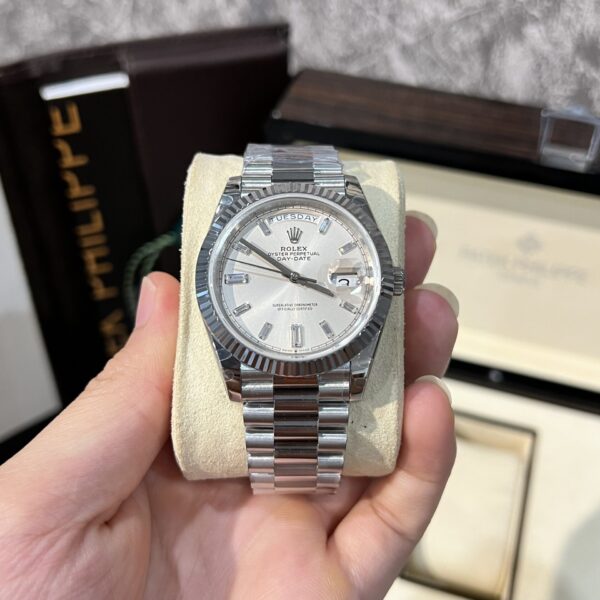
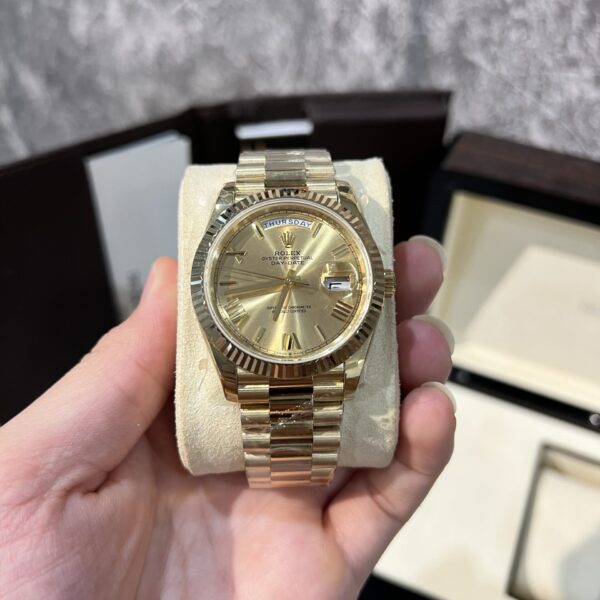
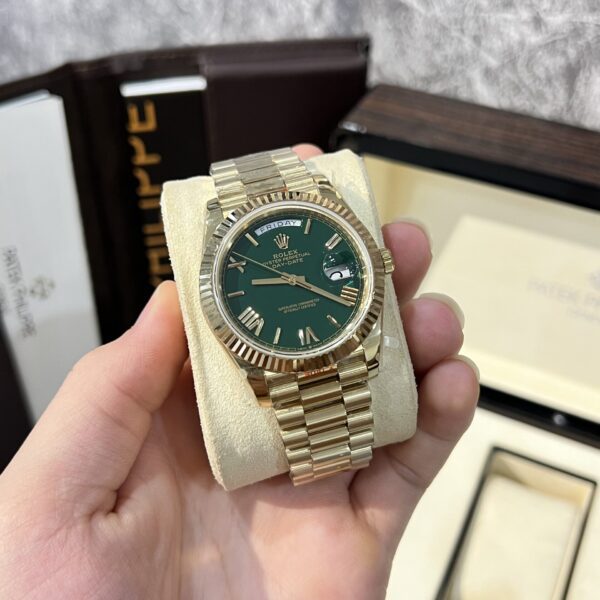
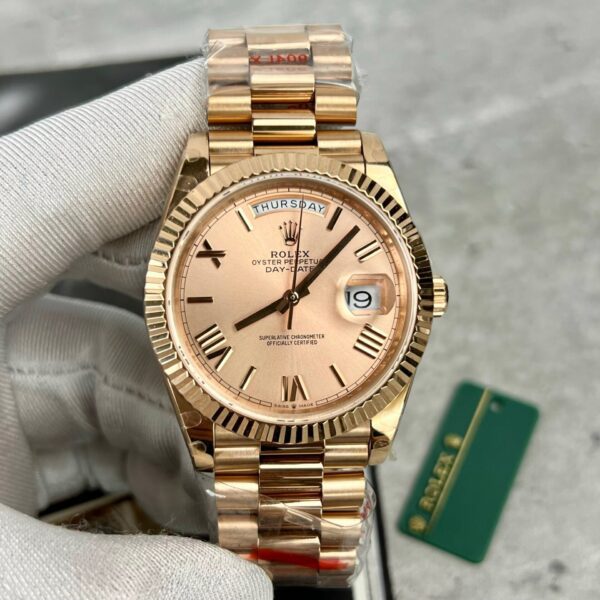
Our Day-Date collection includes 36mm and 40mm configurations in yellow-gold, rose-gold and white-metal styles, along with green, champagne, black, chocolate, ombré, meteorite-style and stone-set dials.
If you are buying your first higher-end replica, our super clone watch buying guide is a useful starting point before getting buried in factory names and movement numbers.
What Makes a Good Day-Date Super Clone?
People usually start with the dial.
I would start with the whole watch.
Does the color look consistent?
Does the bracelet hang naturally?
Does the watch have the kind of presence you expect from a precious-metal design?
Then move inward.
Check the fluted bezel. Check the day window. Look at several dates if possible. Look through the Cyclops. Check the hands and markers.
There is no single detail that makes a Day-Date convincing.
It is the combination.
Day-Date 40mm Super Clone Watches
The 40mm Day-Date has much more wrist presence than the traditional 36mm version.
The dial feels broader, the President bracelet looks heavier and the entire watch makes a stronger statement.
That is probably why so many modern Day-Date replicas concentrate on the 40mm size.
But going larger also makes certain details easier to see.
The fluted bezel occupies more visual space. Dial color becomes more obvious. The day window stretches right across the top of the dial, so poor text alignment is difficult to ignore.
Then there is weight.
This matters more on a Day-Date than it does on something like a stainless-steel Submariner because the design is associated with precious metal. If the watch looks like solid gold but feels unusually light, your brain notices the contradiction almost immediately.
That does not mean heavier is automatically better.
Balance matters.
Our guide to watch weight explains why believable weight and weight distribution usually matter more than simply chasing the highest number on a scale.
Day-Date 36mm Super Clone Watches
The 36mm Day-Date feels completely different.
It is more restrained. The proportions are tighter, and the President bracelet seems to flow into the case rather than sitting beneath a large watch head.
That smaller size does not give factories much room to hide mistakes.
If the bezel is too wide, the dial starts feeling crowded. If the day lettering is too large, you see it immediately. If diamond markers are oversized, the whole balance of the dial changes.
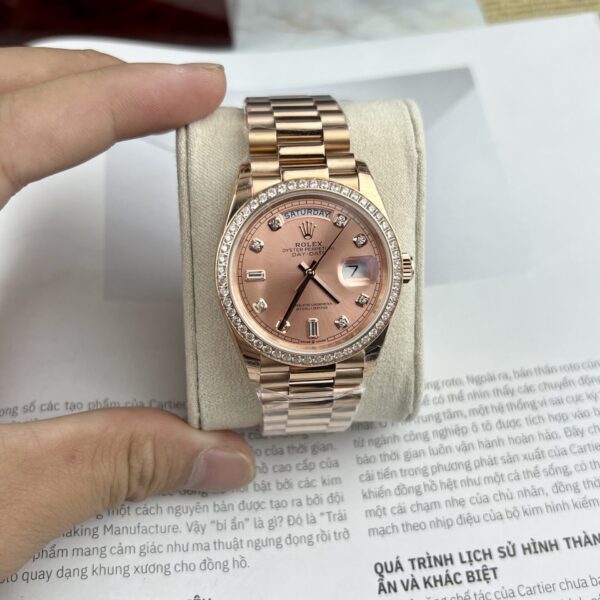
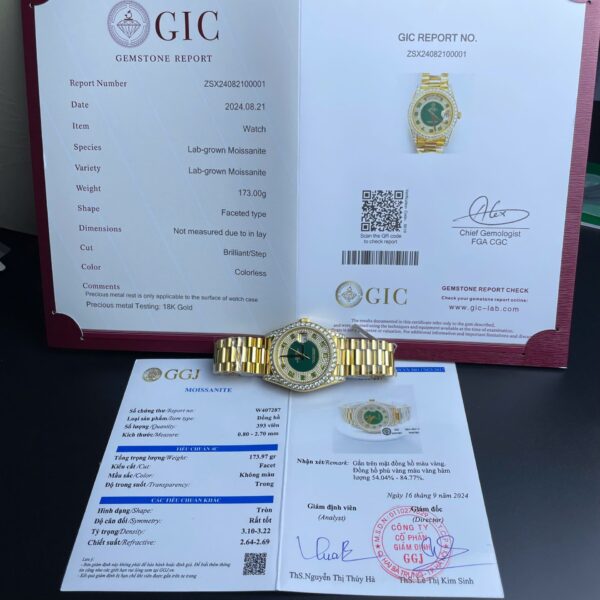
One example currently in the SuperCloneReps catalog is the Day-Date Green Ombré Gold-Wrapped 36mm, which also shows how dramatically a custom dial and stone-set bezel can change the personality of the basic Day-Date shape.
For buyers who prefer traditional proportions, I would not dismiss 36mm because 40mm happens to be more fashionable.
A well-proportioned 36mm Day-Date still looks exactly like what it is supposed to be: a dressier Rolex-style watch rather than an oversized sports watch.
36mm or 40mm?
This is mostly a wrist decision.
Forty millimeters gives you more presence. The dial is easier to read and unusual colors make more of an impact.
Thirty-six millimeters wears quieter and generally feels closer to the traditional Day-Date silhouette.
Neither one is automatically better.
I would look at watches you already own.
If 40mm sports watches already feel normal on your wrist, the Day-Date 40 is probably not going to surprise you.
If you prefer watches that slide under a cuff and do not dominate your wrist, 36mm makes more sense.
Do not buy the size somebody on a forum tells you a man or woman is supposed to wear.
That gets silly pretty quickly.
The President Bracelet Is Half the Watch
People spend twenty minutes studying a Day-Date dial and about twenty seconds looking at the bracelet.
Backwards.
The President-style bracelet is one of the defining parts of the Day-Date.
Its rounded three-piece links give it a very different feel from an Oyster or Jubilee bracelet. The bracelet catches light constantly, and on a gold-tone watch it represents a huge percentage of what you actually see.
Check how the links articulate.
Look at the gaps between them.
Look at how the end links meet the case.
Operate the clasp.
Then pick the watch up by the head and let the bracelet hang naturally.
A decent bracelet should drape rather than looking like a rigid metal band.
This becomes even more important with weighted versions because extra mass does not help if the bracelet itself feels poorly constructed.
Our bracelet quality guide covers the things buyers tend to notice only after they have worn the watch for a while.
Why Weight Matters So Much on a Day-Date
A steel watch can be a little light and still feel plausible.
A gold Day-Date creates different expectations.
You see a substantial gold-colored case and bracelet, so you expect some weight when you pick it up.
This is why weighted Day-Date replicas have become interesting to buyers.
The point is not to make the watch as heavy as possible.
A brick on your wrist is not automatically more accurate.
The point is making the relationship between appearance and feel more believable.
Also consider where the weight sits.
A heavy watch head attached to a very light bracelet can feel strangely top-heavy. A properly balanced watch usually feels better even if its total weight is slightly lower.
Numbers are useful.
Your wrist tells you more.
Yellow Gold Day-Date Super Clones
Yellow gold is probably the least forgiving Day-Date color.
Everybody knows roughly what yellow gold is supposed to look like.
Too yellow and the watch starts looking artificial.
Too pale and it loses the warmth people expect.
The bigger problem is inconsistency.
Look at the case.
Now the bezel.
Then the bracelet.
Then the crown.
If one part seems noticeably different from another under the same light, that is much harder to ignore than a tiny difference in dial printing.
Video is extremely useful here because polished gold-tone surfaces can change dramatically depending on the angle.
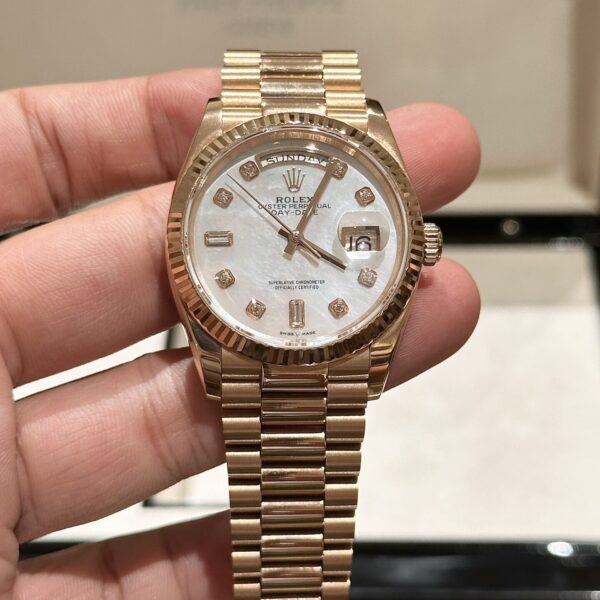
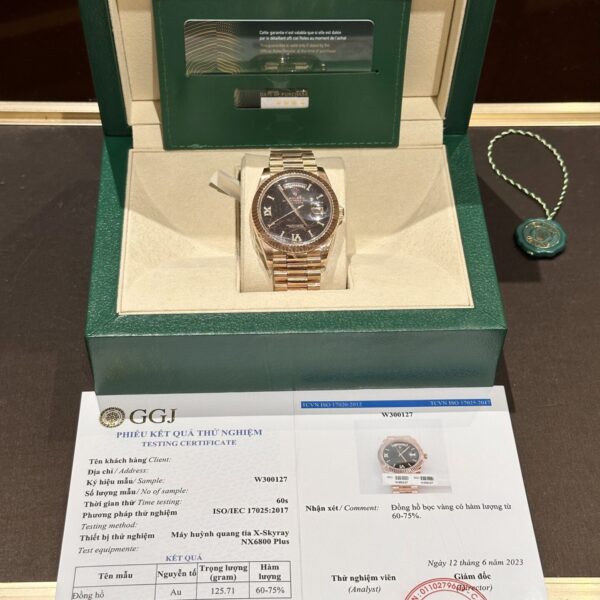
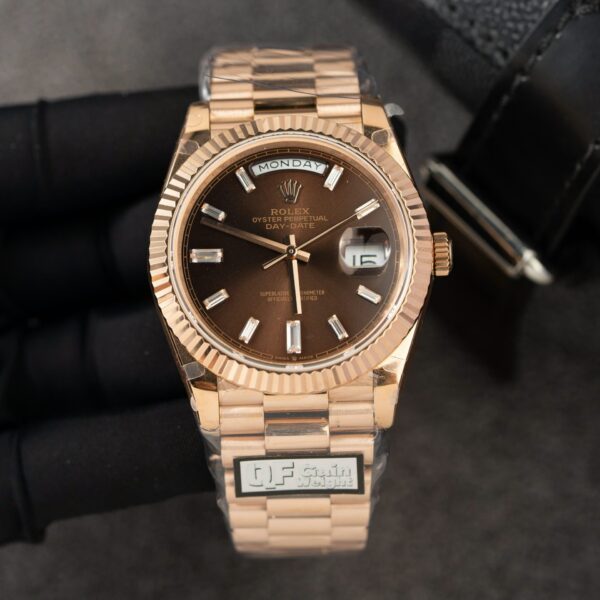
Everose and Rose-Gold Day-Date Replicas
Rose-gold tones create the same problem in a different color.
Some replicas go too pink.
Others look almost copper.
Under warm indoor lighting you may not notice it. Take the same watch outside and the color can suddenly look completely different.
This is why I would never judge a rose-gold Day-Date from one studio photograph.
Look at multiple photos if possible.
Look at video.
And pay attention to whether the bracelet and case appear to belong to the same watch.
Gold Wrapped vs Gold Plated
This terminology creates a lot of confusion.
Replica listings can use terms such as plated, wrapped, coated or gold-tone, and those words do not always describe exactly the same process from one supplier to another.
Do not assume a marketing term tells you everything you need to know about thickness, composition or durability.
The useful questions are simpler.
What is the base material?
What finishing process was actually used?
How consistent is the color?
What happens if the surface is scratched?
And how should the watch be cared for?
I would rather have a clearly described finish than an impressive-sounding phrase with no useful information behind it.
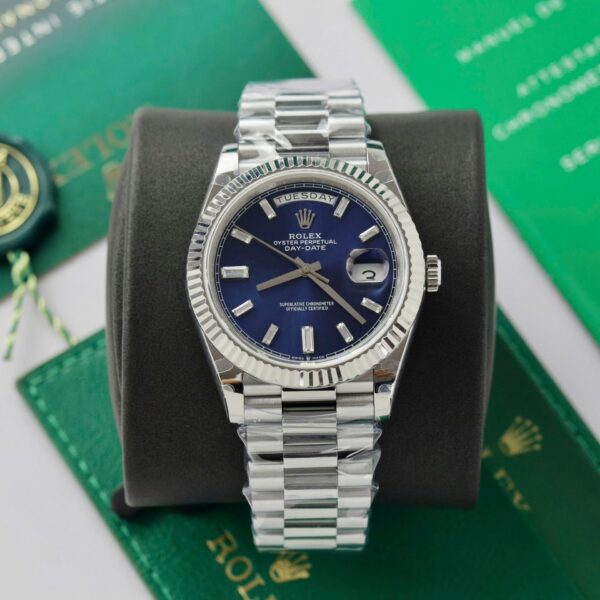
The Day Window at 12 O’Clock
This is what separates a Day-Date from a Datejust at a glance.
The full day spelled across the top of the dial creates another alignment point factories need to get right.
Look at whether the word appears naturally centered.
Then change the day.
Wednesday occupies the window differently from Friday.
Saturday is longer than Monday.
You cannot judge the entire day wheel from one word.
The same basic rule applies as it does to the date:
Look for consistency, not one perfect example.
The Date Window and Cyclops
The day gets all the attention because it is unusual.
You are still going to look at the date more often.
Check several numbers whenever possible.
A single-digit date will naturally sit differently from something like 18 or 28. What you want is a wheel that remains visually centered enough that nothing immediately looks strange.
The Cyclops adds another variable.
If its position or magnification feels wrong, an otherwise acceptable date can suddenly look off.
Our Date Window Alignment Guide goes deeper into checking different numbers without turning QC into pixel measurement.
Fluted Bezel: More Important Than It Looks
The Day-Date does not give you a ceramic sports bezel to inspect.
Instead, you get fluting.
And fluting is all about light.
A good bezel changes constantly as you move your wrist. One section becomes bright while another disappears into shadow.
If the grooves are too soft or shallow, the bezel can look flatter than it should.
This is another area where a video is much more useful than one front-facing photograph.
Look at the watch while it moves.
You are going to wear it while it moves.
Green Day-Date Dials
Green has become one of the colors buyers search for most aggressively.
It is also annoying to judge online.
Dark green can look almost black under one light and surprisingly vivid under another.
Sunburst-style finishes make things harder because the direction of the brushing changes the apparent color depending on where the light is coming from.
If you are buying a green Day-Date, I would focus less on whether one photograph matches an online reference image and more on how the dial behaves across several angles.
A good dial should have some life to it.
It should not look like a flat green circle pasted into the case.
Champagne Day-Date Dials
Champagne sounds simple.
It is not.
There is a very small distance between a warm champagne dial and a yellow dial that looks cheap.
The relationship with the case color matters too.
If the dial and bracelet are almost exactly the same tone, everything can blend together. If the difference is too extreme, the dial looks like it came from another watch.
This is one of those combinations where judging the complete watch matters more than comparing one RGB value on a screen.
Ice Blue, Chocolate, Black and Ombré Dials
This is where Day-Date collecting gets dangerous.
You start looking for one watch and end up with fifteen browser tabs open.
Ice-blue-style dials give the watch a completely different character from yellow-gold champagne configurations.
Chocolate works particularly well with rose-gold tones.
Black creates contrast and makes the case and bracelet more dominant.
Ombré dials shift from lighter centers toward darker edges and can look completely different depending on the photography.
There is no universal “best” Day-Date dial.
That is probably why people keep buying different ones.
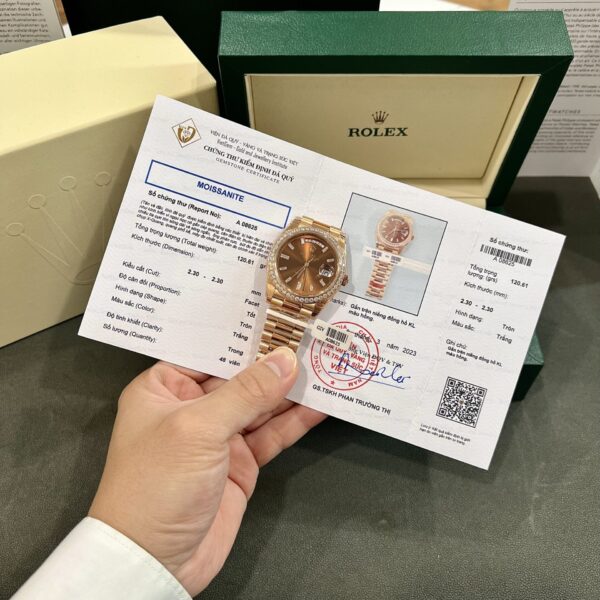
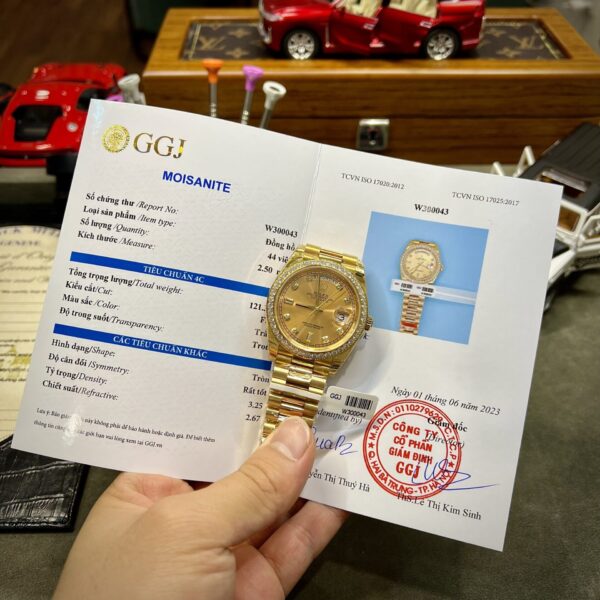
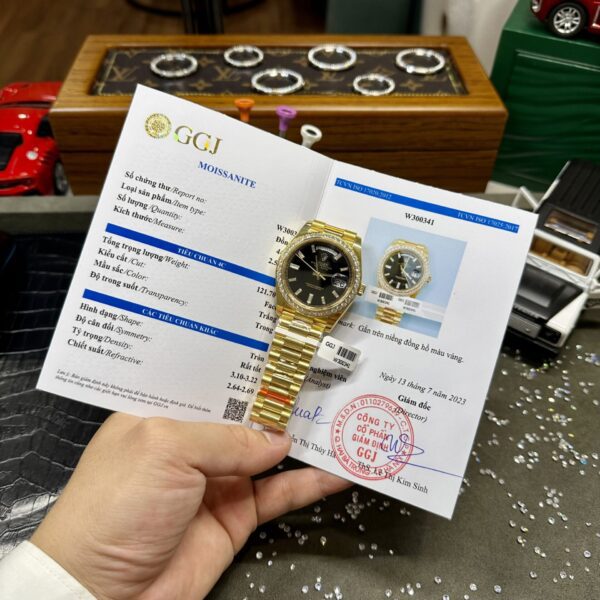
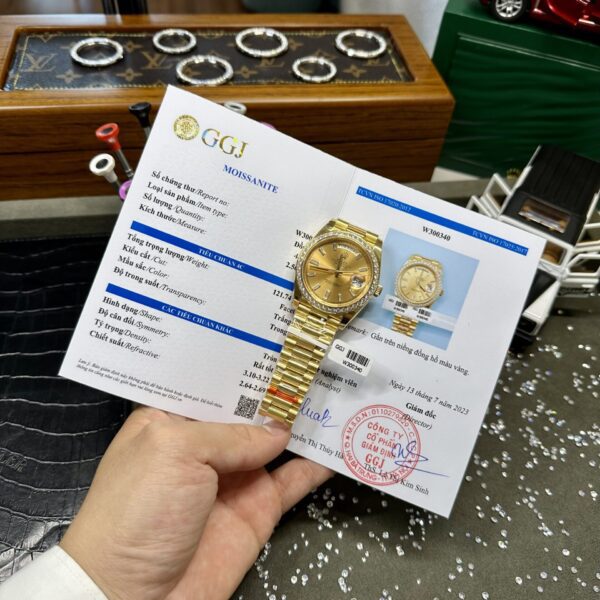
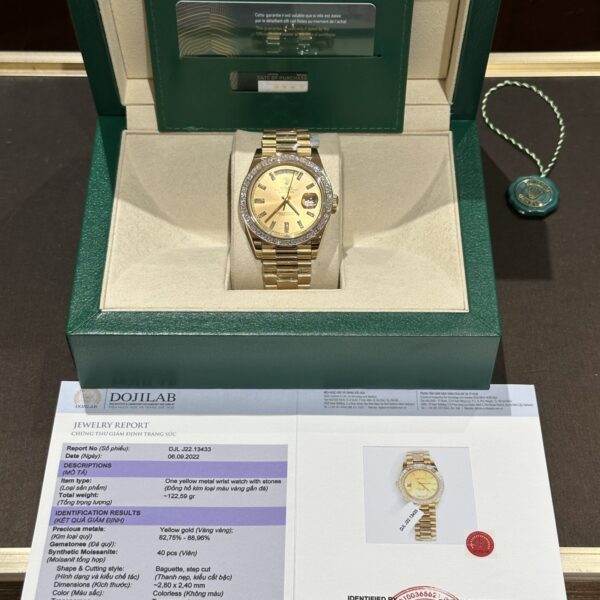
Diamond and Moissanite Day-Date Watches
A plain Day-Date is already flashy.
Then somebody adds stones.
Once a watch has a diamond-style bezel, baguette markers or a fully set bracelet, you need to inspect two things separately:
The watch.
And the setting.
Do not let sparkle hide basic QC problems.
Check whether the dial is straight and whether the day and date displays work correctly first.
Then look at the stones.
Are the rows straight?
Are the gaps reasonably consistent?
Do the stones sit at similar heights?
Does the setting look clean around the edges?
Bright video lights make almost everything sparkle.
Alignment tells you more.
Meteorite-Style Day-Date Dials
Meteorite-style dials deserve their own mention because the pattern is part of the attraction.
You do not want something that looks like a repeating graphic.
Natural-looking variation matters more than having one exact line in one exact position.
Also remember that customized meteorite-style and stone-set replicas are not necessarily attempts to duplicate a standard factory configuration exactly.
Some are custom watches inspired by combinations collectors like.
Judge them accordingly.
3255-Style Clone Movements
The movement conversation on a Day-Date is more important than it initially appears because the watch has two calendar displays to operate.
You are not just setting the time.
You interact with the date.
You interact with the day.
You feel the crown and setting positions.
Modern higher-end replica movements include 3255-style clone architectures, but the number printed in a listing should never be the end of your research.
What matters is how the actual movement behaves.
Does winding feel smooth?
Do the setting positions engage properly?
Does the day advance?
Does the date advance?
Does the movement keep reasonable time?
Our guide to clone movement longevity explains why movement quality is better judged over ownership than from impressive specifications alone.
Do the Day and Date Change Correctly?
This is something I would specifically ask to see in QC video when practical.
A Day-Date should not simply display the right words and numbers.
The calendar mechanism needs to operate.
Check that the crown positions work correctly and that the day and date can be adjusted as intended by the replica movement.
Do not expect every clone movement to reproduce every genuine mechanical behavior identically.
What matters is knowing what the watch you are actually buying does.
Which Factory Makes the Best Day-Date?
I would be careful with anybody who gives one factory name and ends the conversation there.
Day-Date replicas have too many variables.
One version may have better weight.
Another might have a dial you prefer.
Another may have cleaner day and date alignment.
Factories revise models too.
A batch that received great reviews a year ago is not automatically identical to what is being produced today.
Use factory reputation to build a shortlist.
Then compare the actual reference, movement, weight, finish and current QC examples.
That is also the approach we use across SuperCloneReps. You can read more about why we evaluate watches reference by reference on our About SuperCloneReps page.
What We Check During Day-Date QC
I would start without zooming.
Look at the watch as a complete object.
Does the dial look straight?
Does the bezel sit naturally around it?
Does the day appear centered?
Does the date immediately look strange?
Then get closer.
Inspect the dial markers and hands.
Check more than one date where possible.
Check more than one day.
Look at the Cyclops.
Then inspect the case and bracelet for scratches, unfinished areas or obvious color differences.
Operate the clasp.
Check the crown.
Test the calendar functions.
Finally, look at the movement’s timing behavior where testing is available.
Our Rolex super clone QC process explains how the individual watch is checked before dispatch rather than relying only on factory stock photos.
If you are reviewing your own QC set, use our QC photo guide as a checklist.
Do Not Spend an Hour Inspecting One Letter
This happens with the Day-Date.
Someone zooms into the word “Wednesday.”
Then they compare the W against twenty photographs online.
Then another photo was taken at a slightly different angle, so the word appears shifted.
Suddenly an hour is gone.
Meanwhile, nobody checked whether the bracelet clasp closes properly.
QC should catch things that will affect ownership.
If the day display is visibly crooked, that matters.
If the date is constantly sitting against the edge of the window, that matters.
If the bracelet has a sharp unfinished edge, you will feel it.
If you need extreme enlargement to decide whether one letter might be fractionally thicker, it probably deserves less of your attention.
Which Day-Date Should You Choose?
Start with size.
36mm for the traditional proportions.
40mm for more wrist presence.
Then decide what kind of metal appearance you want.
Yellow gold is the classic Day-Date look.
Rose gold feels warmer.
White-metal configurations are much quieter.
After that, choose the dial.
This is where most buyers make the decision anyway.
Green. Champagne. Chocolate. Black. Ice blue. Meteorite-style. Ombré. Diamond markers.
Pick the one you actually want to see when you look down at your wrist.
Then worry about factory, movement and production version.
Doing it in that order saves a lot of pointless comparison.
Explore Rolex Day-Date Super Clone Watches
Browse our Day-Date collection to compare 36mm and 40mm configurations across different dial colors, President-style bracelets, gold-tone finishes, weighted constructions, factories and movements.
For deeper comparisons covering QC, movement reliability, watch weight, bracelets and factory differences, visit our watch guides and reviews.
The Day-Date is one of those watches where the specification sheet only tells part of the story.
You can see the dial in photographs.
You cannot really photograph how a President bracelet feels around your wrist.
You can list the weight in grams.
You cannot put balance into a product title.
And you can write “gold” a dozen different ways without showing how the color actually behaves in daylight.
Those are the things I would pay attention to.
Important: Watches offered by SuperCloneReps are independent reproductions. They are not manufactured, sponsored, approved or endorsed by Rolex SA and should never be represented or resold as authentic Rolex watches.
-

-
-
-
-
-
-
-
-
Day-Date
Rolex Day-Date Super Clone Watch Gold Wrapped Moissanite Baguette Diamond 40mm
Price range: $1,200.00 through $1,600.00Select options This product has multiple variants. The options may be chosen on the product page -
Day-Date
Rolex Super Clone 11 Watch Day-Date Rose Gold Wrapped Lava Dial 40mm
Price range: $1,200.00 through $1,600.00Select options This product has multiple variants. The options may be chosen on the product page -
-
Day-Date
Rolex Day-Date Super Clone Watch Gold Wrapped + Moissanite Diamonds Weight 173 Gram 40mm
Price range: $1,200.00 through $1,600.00Select options This product has multiple variants. The options may be chosen on the product page -
-
-
-