
No products in the cart.
Blog
VSF 3135 Movement vs Genuine Rolex 3135: What the Close-Up Photos Reveal
An older set of VS Factory comparison photographs provides a look at those details. The images place a VSF 3135-style movement alongside a movement labeled as a genuine Rolex 3135 and a lower-cost aftermarket version identified in the original Chinese material as a “blue hairspring” 3135.
There are also several close-ups of green Submariner ceramic bezel inserts, including two different production versions.
These are manufacturer-supplied photographs rather than the results of an independent examination. They are useful for seeing differences in construction, although claims about durability, precision and component compatibility need more evidence than pictures can provide. Some English comparison graphics are illustrative recreations rather than untouched source photographs.
Three 3135 Movements, Three Different Approaches
The movement comparison is arranged in three columns. VS Factory’s 3135 sits on the left, the genuine-labeled Rolex calibre 3135 in the middle, and the aftermarket movement on the right.
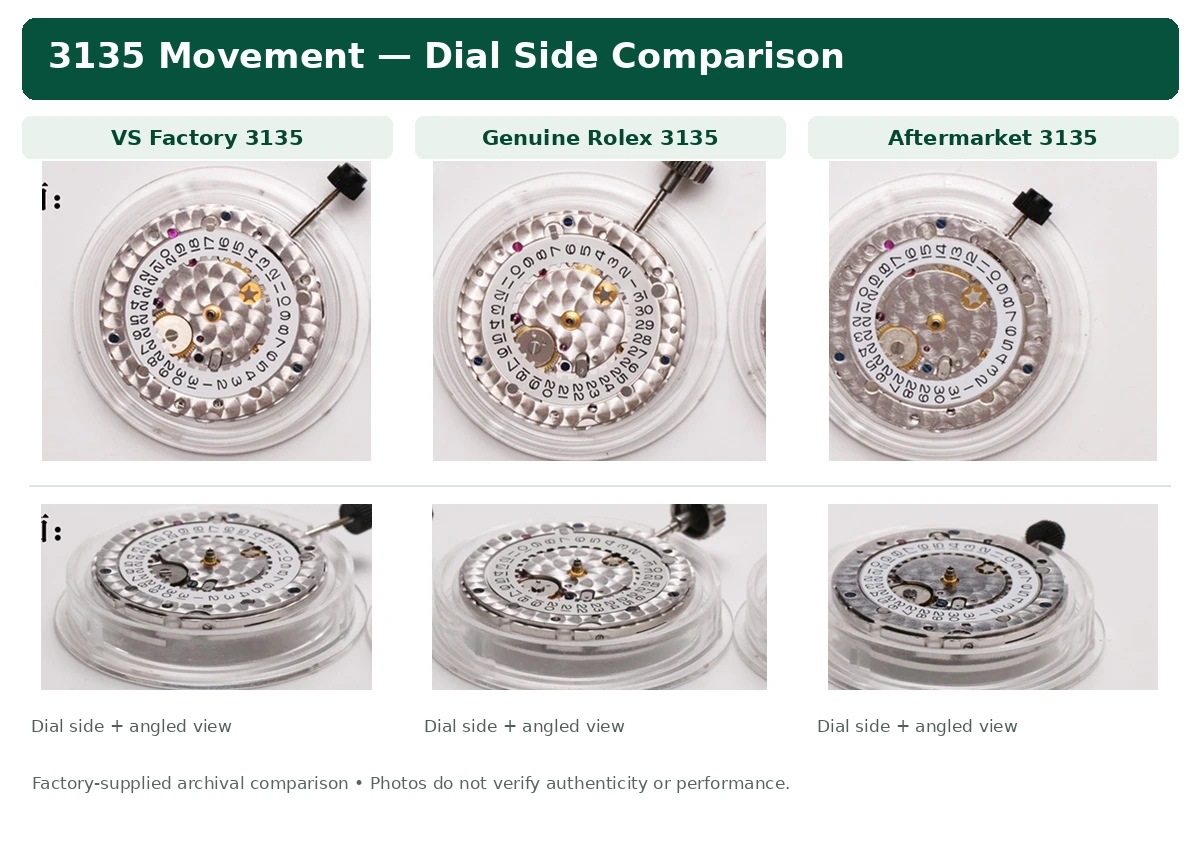
The third movement is described as a “blue hairspring” 3135. That is the supplier’s terminology, not a standard name covering every aftermarket 3135 movement. Different manufacturers have produced their own interpretations of this calibre, and their construction can vary considerably.
The genuine Rolex 3135 is an automatic movement with a date complication, introduced in 1988 and used in numerous Rolex models over the following decades. Its architecture is familiar to watchmakers, particularly the arrangement of the automatic winding system, date mechanism, bridges and balance assembly.
A clone-style 3135 attempts to reproduce elements of that design. The question is how far the resemblance extends beneath the visible plates.
Two movements may share the same general layout while using different manufacturing tolerances, wheel materials, jewel settings or finishing processes. Those differences are difficult to establish from an assembled watch. Even with close-up photographs, some of the most important mechanical details remain hidden.
In this particular comparison, the VSF example follows several visible construction details of the genuine-labeled movement more closely than the generic aftermarket sample. That observation is worth exploring, but it should not be mistaken for proof that the movements are mechanically identical.
Green Submariner Bezel Comparison: The Earlier and Later Versions
Before getting into the movement itself, the first five source images examine the ceramic bezel insert fitted to a green Submariner-style watch. The supplier compares two inserts identified by their markings: Clean-V3-1-4 and Clean-V3-1-10.
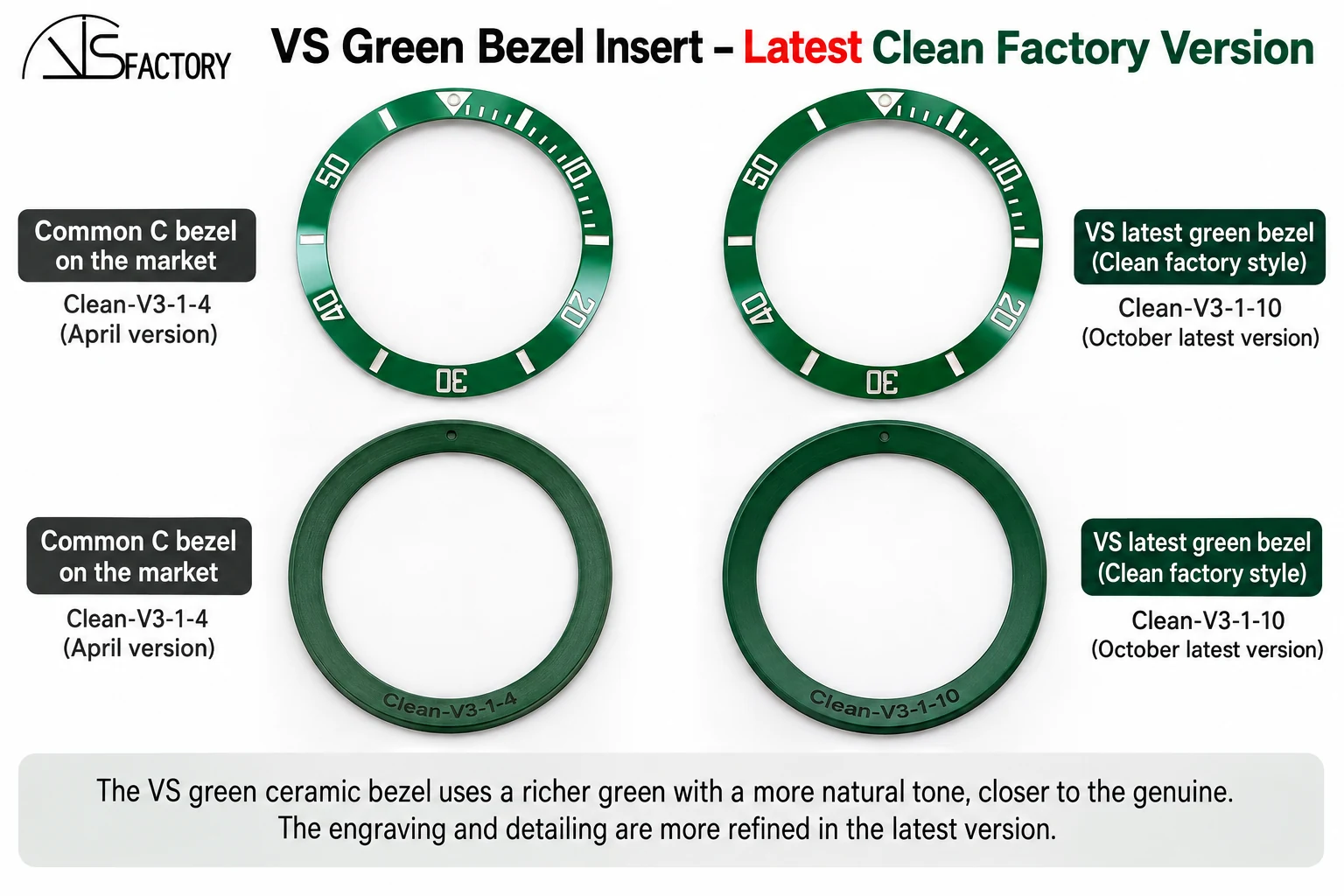
The original Chinese heading describes a VS Factory green Submariner using a newer Clean Factory bezel insert. These identifiers belong to the pictured material and should not be assumed to represent current production.
Looking at both inserts from the front, the color difference is noticeable. The later example appears darker and more saturated, while the earlier insert carries a slightly lighter tone. The manufacturer describes the newer green as more natural and less yellow.
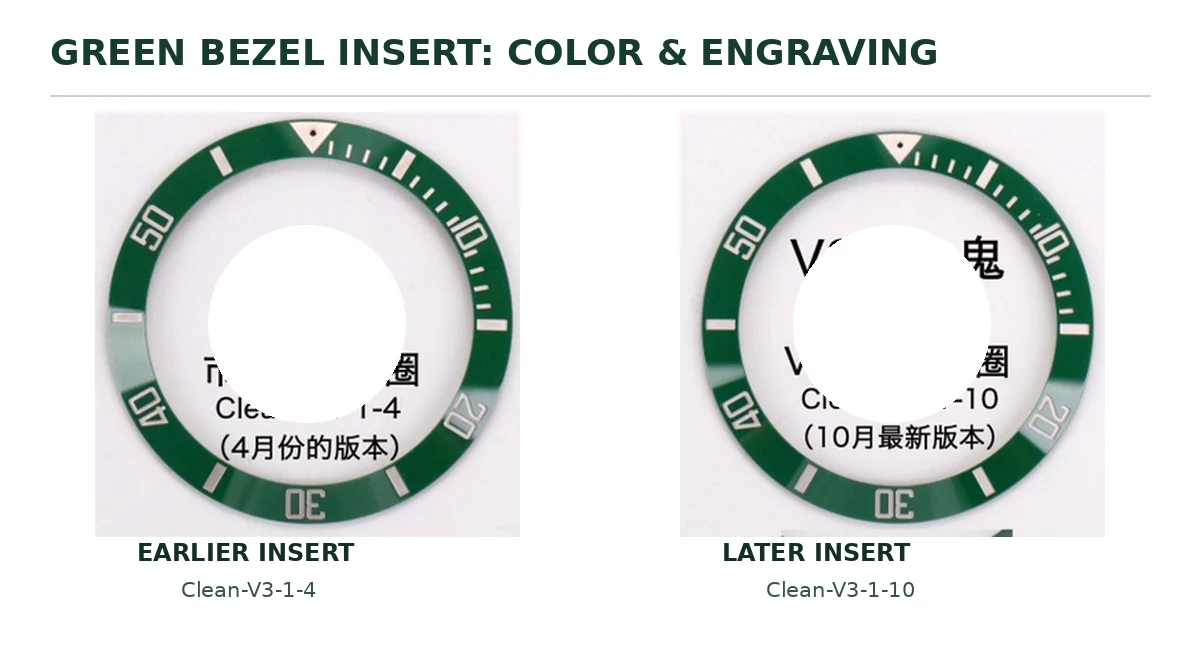
Green ceramic is particularly difficult to judge from photographs. Under cool lighting, the same surface can appear different from how it looks in daylight. Camera settings and image processing introduce another variable. Without a genuine bezel photographed under identical conditions, an exact color match cannot be established here.
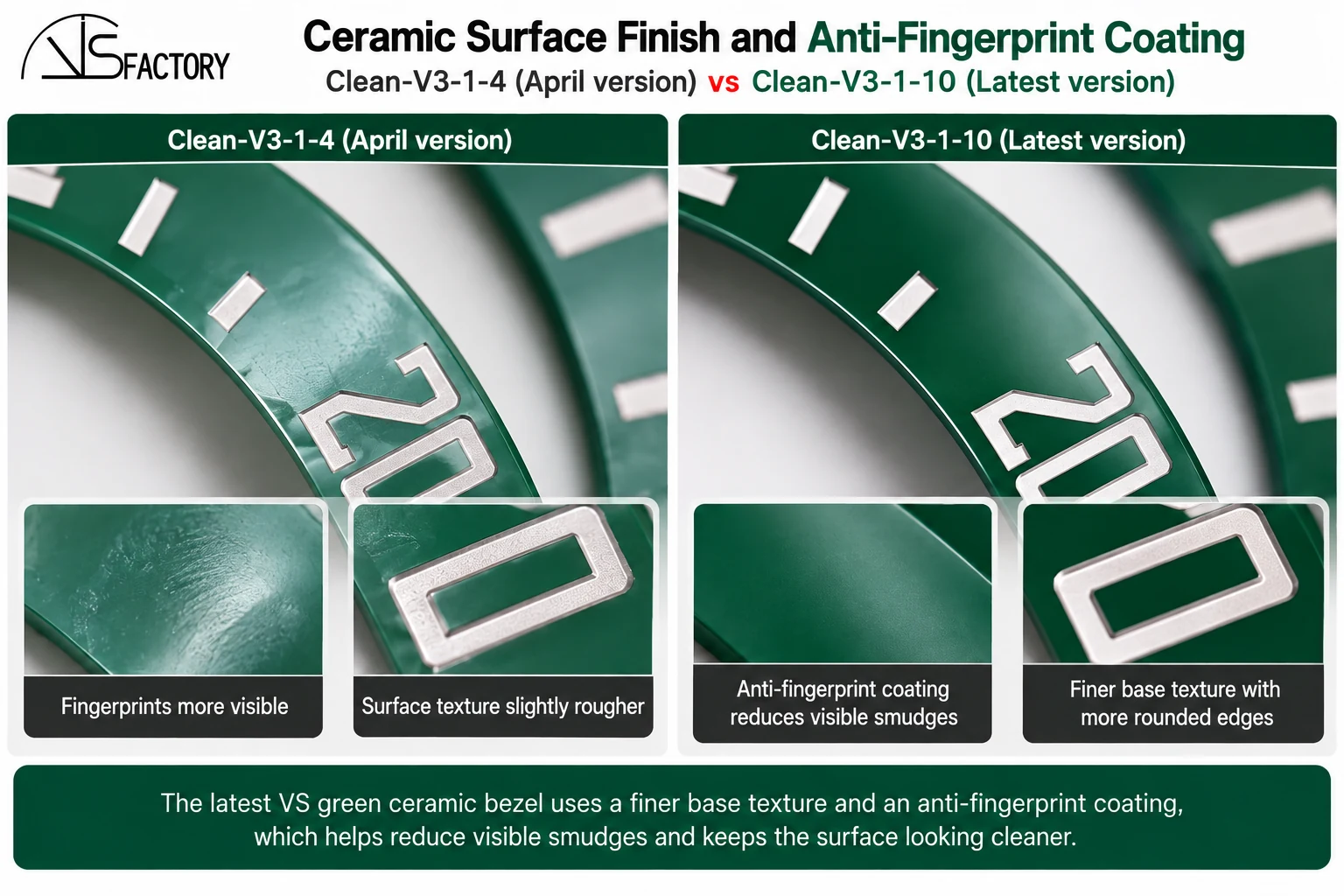
The close-up comparisons are more useful. Around the numerals and minute markers, the metallic-colored filling meets the engraved ceramic at a narrow border. It is a small detail, but differences become visible under magnification.
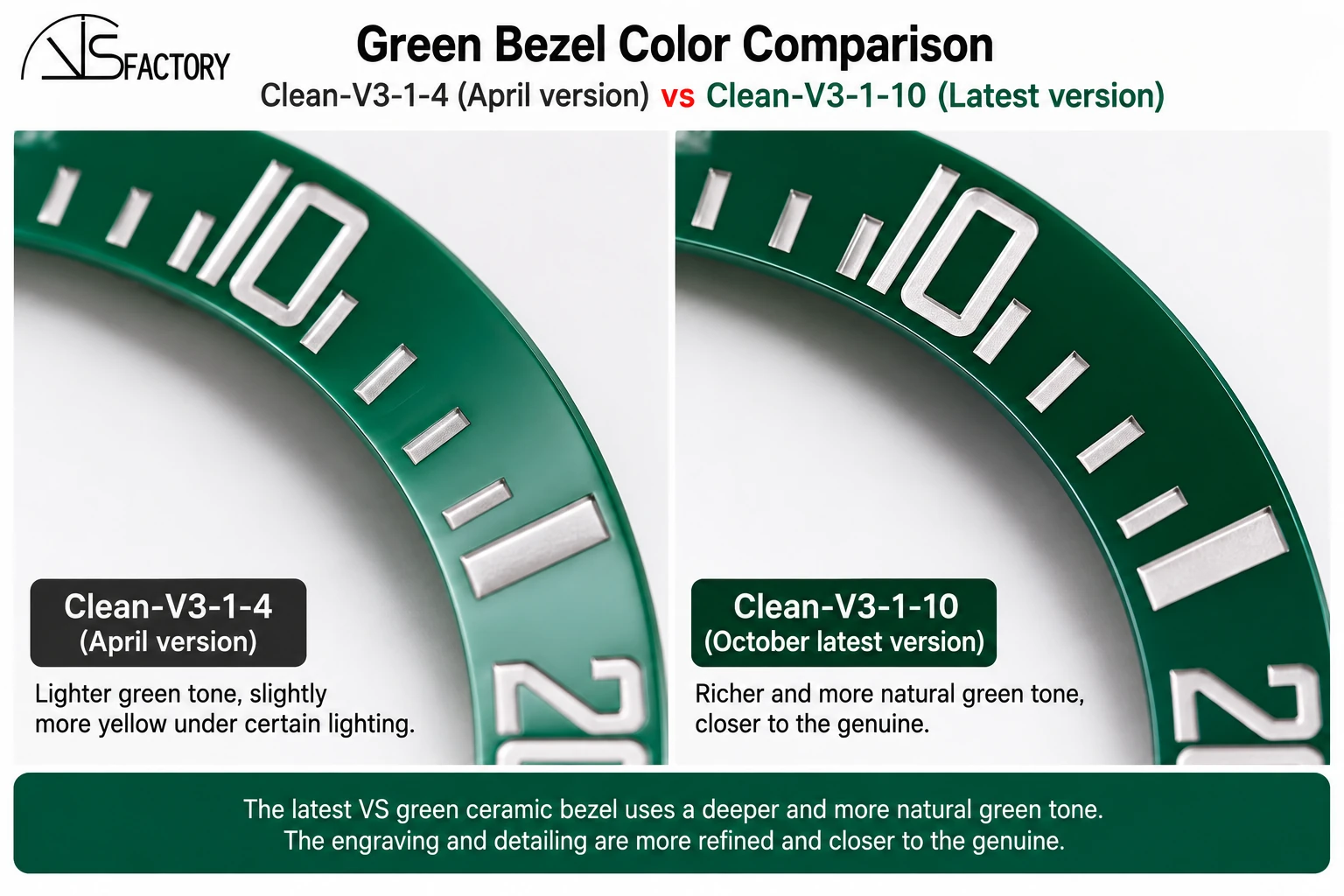
The original captions claim the later insert uses a brighter platinum-silver-colored filling and more carefully finished numeral edges. In the photographs, the borders around some of the markers appear more defined on the later insert.
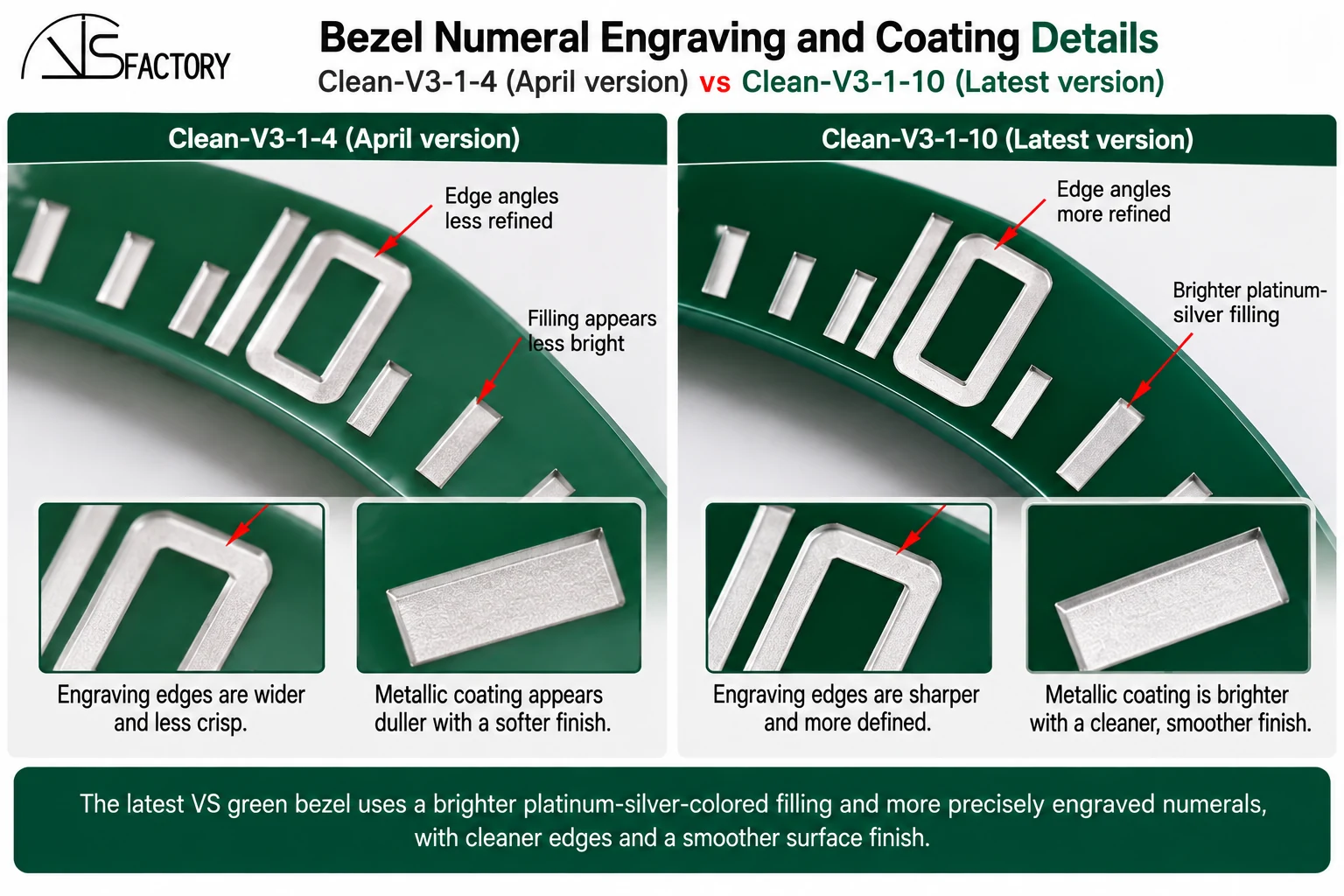
The manufacturer also points to changes in the texture beneath the coating and the shape of the edges. One further claim concerns fingerprints. According to the supplied material, the later insert received a coating intended to reduce visible fingerprint marks.
The image suggests a difference in surface appearance, although it does not demonstrate how either bezel behaves after repeated handling. Anyone comparing green Submariner versions should treat these images as a historical production comparison, rather than a guarantee of which bezel insert a particular watch currently uses.
Movement Finishing: Looking Beneath the Surface
The next photographs turn to the VSF 3135 movement itself. From the dial side, the VSF and genuine-labeled examples share a similar arrangement of the date components, screw positions and circular finishing. The third movement follows the broad architecture but displays some visibly different surface treatments.
One area receiving particular attention is the circular decoration on the movement plates. These overlapping patterns are often described as perlage or circular graining. They are created through a finishing process that leaves repeated circular marks across the metal surface.
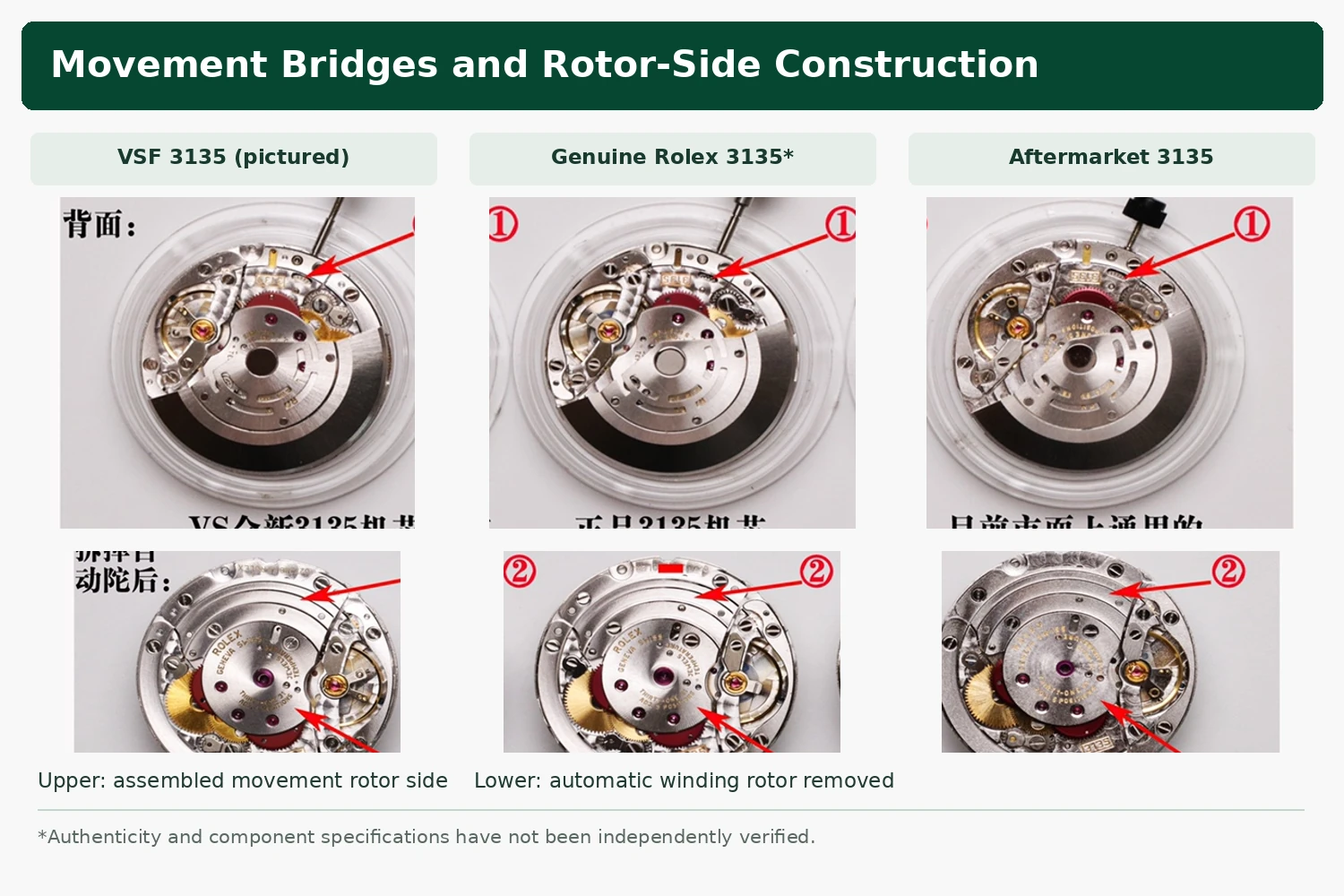
In the supplied photographs, the decoration on the VSF sample appears more clearly defined than on the generic aftermarket movement. A finely decorated plate may indicate additional attention to visual finishing, but that does not automatically establish superior mechanical performance. A movement can have attractive decoration and still suffer from poor adjustment, insufficient lubrication or inconsistent assembly.
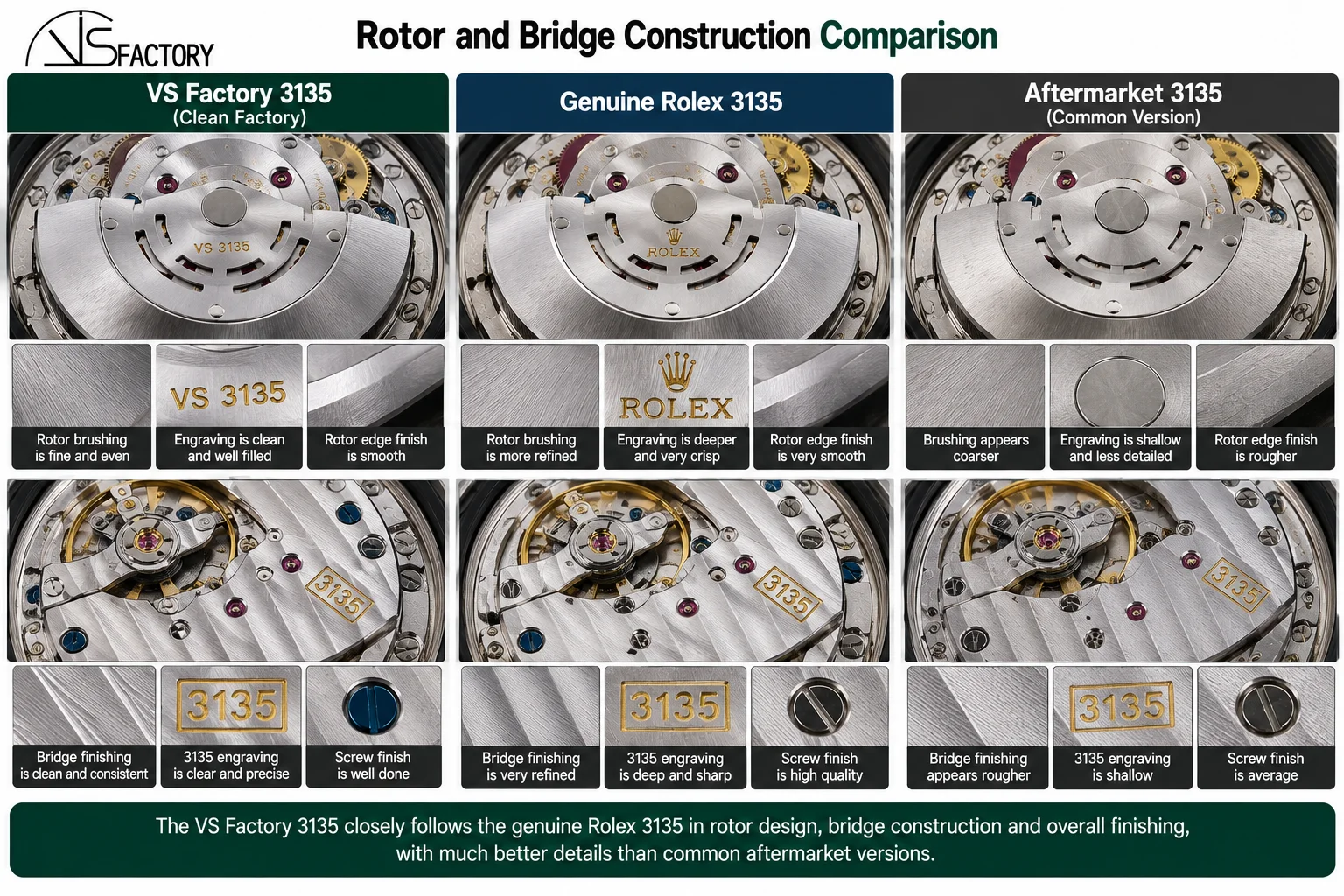
The comparison also draws attention to the engravings. The VSF movement is pictured with Rolex lettering and a serial-style code, while the generic movement is shown without the same markings. That makes the VSF example visually closer to the genuine-labeled movement, but copied markings are not evidence of authenticity.
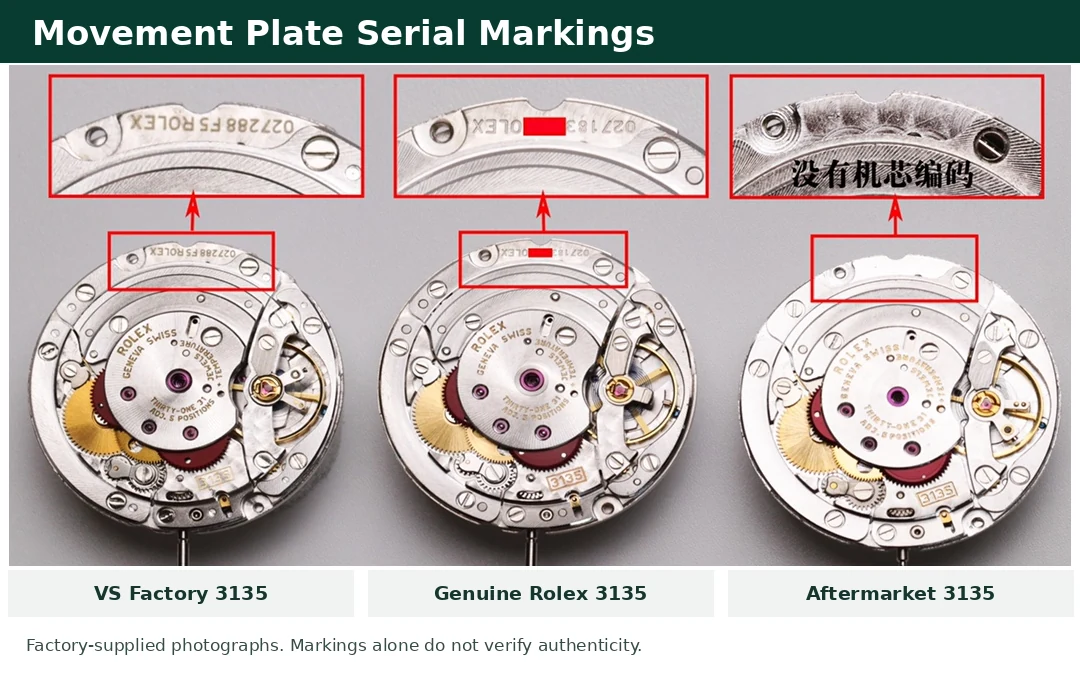
The source and identity of a movement should never depend on the name engraved on one of its plates.
What Changes When the Rotor Comes Off?
With the automatic winding rotor removed, more of the underlying movement becomes visible. The photographs compare the positions of the fastening points and the shapes of the bridges underneath. The original Chinese commentary identifies seven fixed rivets on the VSF and genuine-labeled movements, contrasting them with the construction of the generic aftermarket example.
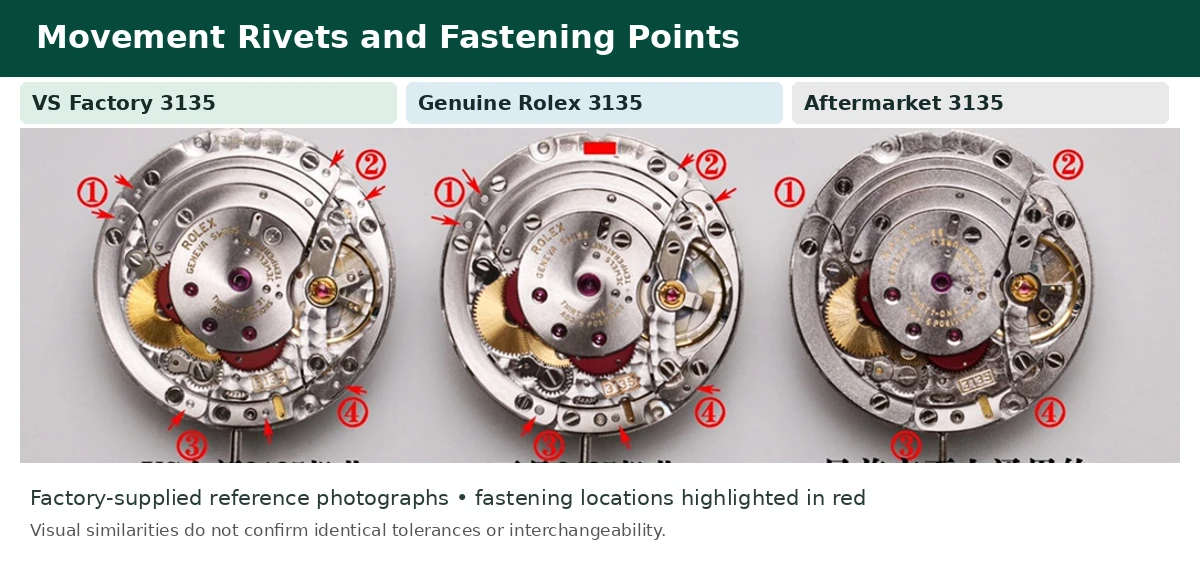
In the close-ups, the first two movements share several fastening positions that appear different on the third. The arrangement of screws, rivets, bridge supports and other fasteners influences how a movement is assembled and serviced. Their precise location can also determine whether a component from one movement fits another. Photographic similarity is a starting point. Actual compatibility would require dimensions, fitting checks and verification by a watchmaker.
Inside the Gear Train: Small Differences in Construction
The gear comparison is one of the more interesting parts of the material. The photographs isolate two small gear-wheel assemblies and show magnified views of their profiles. According to the manufacturer’s explanation, the VSF and genuine-labeled movements use a stepped arrangement, while the generic aftermarket example uses flatter-looking components.
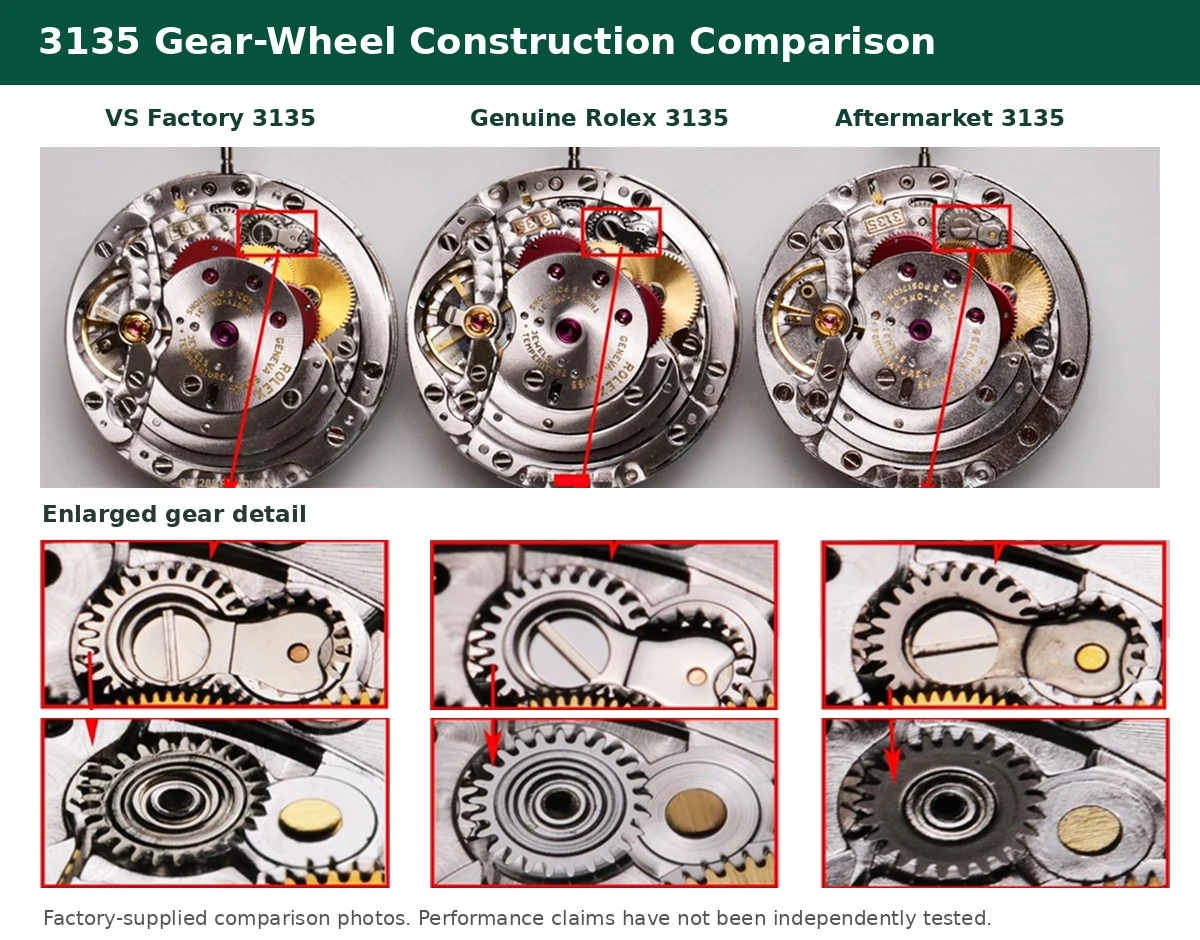
Those shapes are visible in the close-ups. The stepped sections appear more closely matched between the VSF and genuine-labeled examples. The generic movement shows a different construction at the highlighted location.
The supplier argues that this design difference contributes to stability. Wheel support, alignment and engagement matter in watchmaking: a poorly supported or misaligned wheel can introduce friction or wear. Yet the appearance of a stepped gear does not establish how accurately the component was manufactured. An assessment would need tooth geometry, endshake, side shake, material quality, bearing support and performance under load.
Jewel Settings and the Support of Moving Parts
Another slide focuses on the jewel arrangement around the center-wheel assembly. Mechanical watches use synthetic jewels as low-friction bearing surfaces at selected points in the movement. Their placement and support help control the movement of pivots as the gear train operates.
The original comparison claims the VSF and genuine-labeled 3135 examples use a more closely matched arrangement, while the generic movement has a simplified jewel support. From the photographs, differences in the visible support structure can be identified. What cannot be measured is the amount of movement permitted at the pivot.
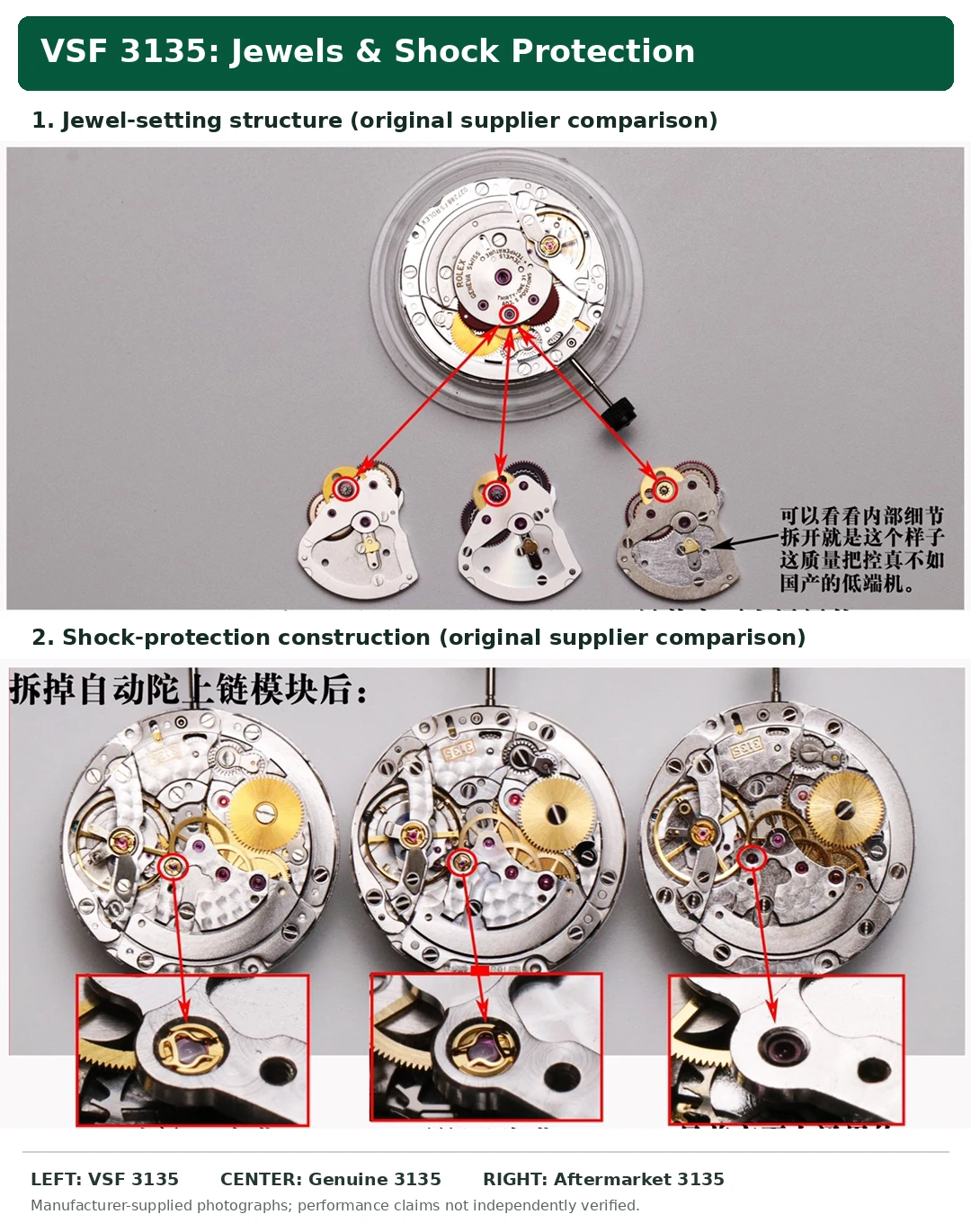
That would require examination of the assembled components, including their clearances and condition. A jewel that looks correctly positioned is not necessarily correctly fitted, just as a simpler-looking arrangement is not automatically defective.
Shock Protection: A Detail That Serves a Purpose
The original Chinese text also highlights the shock-protection mechanism. This is an important part of a mechanical movement because the balance staff and its pivots are vulnerable to impact. Shock-protection systems allow controlled movement of the jewel setting, helping protect delicate components when the watch experiences a sudden force.
The supplier claims the VSF version incorporates a shock-protection arrangement resembling the genuine movement more closely than the generic aftermarket example. The three assemblies do show different visible details. Still, whether one survives impacts better than another cannot be judged from appearance alone. Spring behavior, jewel seating, component dimensions and the movement’s condition all affect performance.
Balance Support and the Older Two-Post Design
Another set of photographs examines a limiting structure positioned beneath a wheel in the movement. The manufacturer identifies an additional two-post arrangement on the generic aftermarket version, which is absent from the highlighted area of the VSF and genuine-labeled examples.
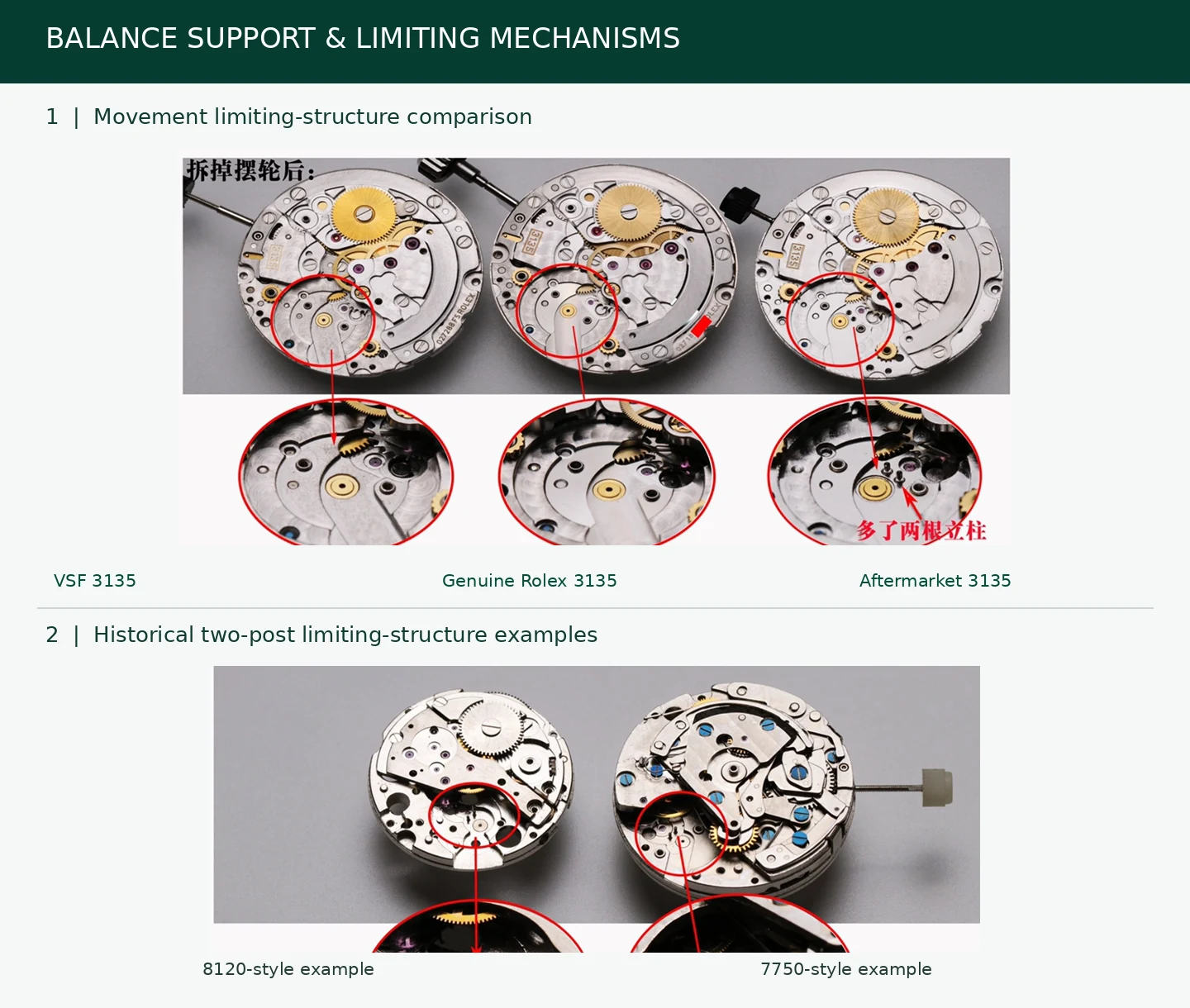
To illustrate the point, the source includes photographs labeled 8120 and 7750, showing similar structures in older movement designs. The argument is that the generic 3135-style movement uses a construction associated with earlier mechanisms, whereas the VSF version follows the pictured genuine arrangement more closely.
This is primarily a comparison of architecture. Older engineering is not automatically inferior. Some mechanisms remain useful for decades, and design complexity does not always correspond to quality. What matters is whether the parts are properly made, correctly supported and suitable for the job they perform. The source does not provide measurements that would allow those questions to be settled.
VSF 3135 vs Genuine Rolex 3135: Timegrapher Results
The manufacturer also photographed each movement on a timegrapher. A timegrapher listens to the operation of the escapement and calculates several measurements from timing signals. It is one of the standard tools used when inspecting or adjusting mechanical watches.
The images show all three movements operating at 28,800 beats per hour, with the instruments set to a 52-degree lift angle.
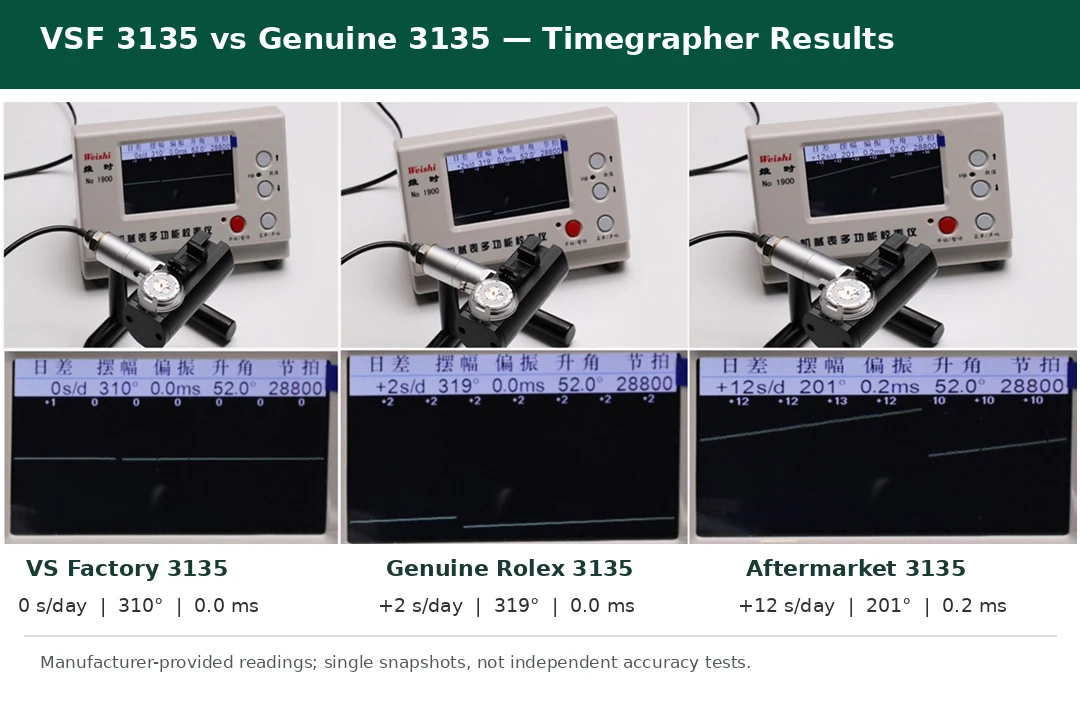
| Measurement | VSF 3135 | Genuine-labeled 3135 | Generic 3135 |
|---|---|---|---|
| Daily rate | 0 seconds/day | +2 seconds/day | +12 seconds/day |
| Amplitude | 310° | 319° | 201° |
| Beat error | 0.0 ms | 0.0 ms | 0.2 ms |
| Beat rate | 28,800 bph | 28,800 bph | 28,800 bph |
These numbers come directly from the supplied factory photographs. They have not been independently reproduced. The VSF sample gives a favorable result in this test, with a displayed rate of zero seconds per day and an amplitude of 310 degrees. The genuine-labeled 3135 shows +2 seconds per day and 319 degrees.
The third movement is noticeably different, showing an amplitude of 201 degrees. That does not necessarily mean every generic aftermarket 3135 movement will produce the same result. Amplitude depends on state of wind, lubrication, movement condition, test position and escapement geometry. The displayed lift-angle setting also influences the calculated amplitude.
A watch can display an excellent rate in one position and behave very differently in another. A proper assessment checks multiple positions and power-reserve states and looks for irregularities in amplitude and beat error. The readings do not establish long-term accuracy or reliability.
Bracelet Spring Bars and End-Link Construction
The final comparison leaves the movement and examines the bracelet hardware. Two pairs of spring bars are shown beside close-up photographs of the end links. The supplier claims the VSF spring bars were made to match genuine parts closely enough to permit interchangeability.
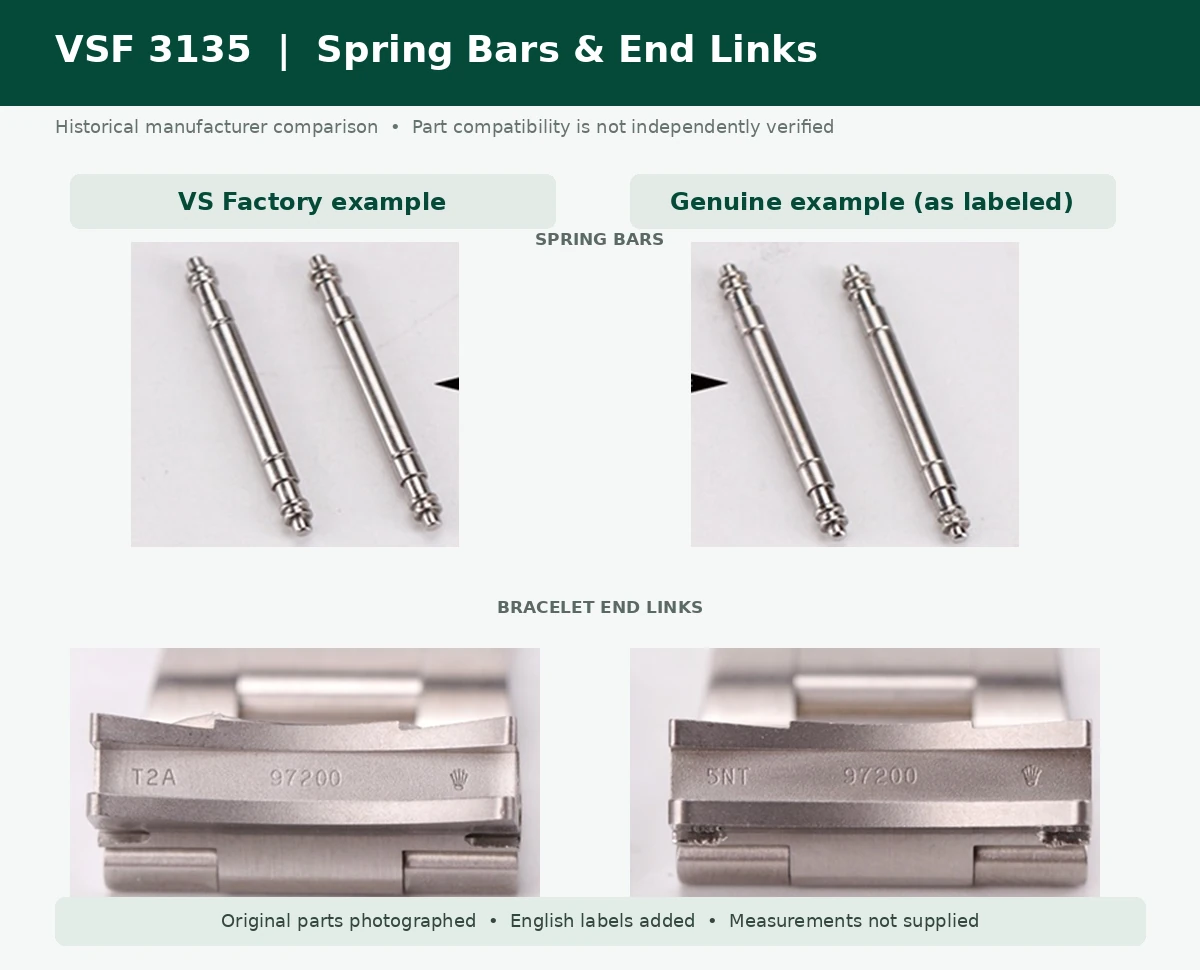
A spring bar may appear simple, but its diameter, shoulder profile and engagement with the lug holes matter. Poor fit can compromise bracelet security. The end link introduces another set of tolerances: its shape determines how neatly the bracelet meets the case, whether the first link moves as intended, and how the assembly feels during wear.
In the pictures, the VSF and genuine-labeled examples show a similar overall appearance. But fitting one component into another watch safely requires more than visual resemblance. Interchangeability remains a manufacturer claim unless the parts have been measured and tested.
What the VSF 3135 Comparison Tells Us
Taken together, the photographs reveal several areas where the pictured VSF 3135 movement follows the genuine-labeled Rolex calibre 3135 more closely than the aftermarket example used in the comparison. The most noticeable similarities appear in the movement layout, plate decoration, selected fastening arrangements, gear construction and some jewel-support details.
The timegrapher results also favor the VSF sample in the particular test shown, although the genuine-labeled movement records an equally strong rate and a slightly higher displayed amplitude. None of this establishes that the VSF movement equals the genuine calibre in materials, manufacturing tolerances, durability or servicing requirements.
There is also the age of the source material to consider. These photographs document a particular comparison and production period. They should not be used to assume that every VSF watch sold today contains the exact same movement or components.
Modern Submariner-style watches may use different movement families altogether. Our VSF Factory watches guide discusses how movement selection varies by model and why the reference number matters when identifying a specific configuration.
For a broader look at movements designed around a particular calibre and more generic alternatives, see our calibre-matched clone movements guide.
The strongest use for these photographs is not to declare a winner. It is to identify the construction details that deserve attention when comparing movements. A closer visual match can be significant, but appearance, measured performance and long-term reliability are three different things. The photographs tell us quite a lot about the first. They offer a limited glimpse of the second. The third remains unanswered.
Editorial note: This article examines historical VS Factory promotional materials originally published with Chinese annotations. Manufacturer claims are presented for analysis and should not be regarded as independently verified. The movement identified as genuine in the supplied material has not been separately authenticated for this article. Some of the English graphics are illustrative recreations.