
No products in the cart.
Blog
Rolex Super Clone QC: How We Inspect Watches Before Shipping
Why “Same Model” Still Arrives Different
Buying a Rolex super clone online comes down to trust. That’s uncomfortable, because a listing is never the whole story.
Most product pages show a polished sample. Your watch might land with a date window that’s slightly off-center, a bezel that doesn’t sit exactly where it should, a clasp that feels rough, or a bracelet screw that isn’t fully seated. Even the movement can behave differently than the example on the page.
So we inspect the specific watch allocated for your order before it ships. Not because we’re trying to “approve” a listing. Because we’re trying to catch problems before you open a box and find out the hard way.
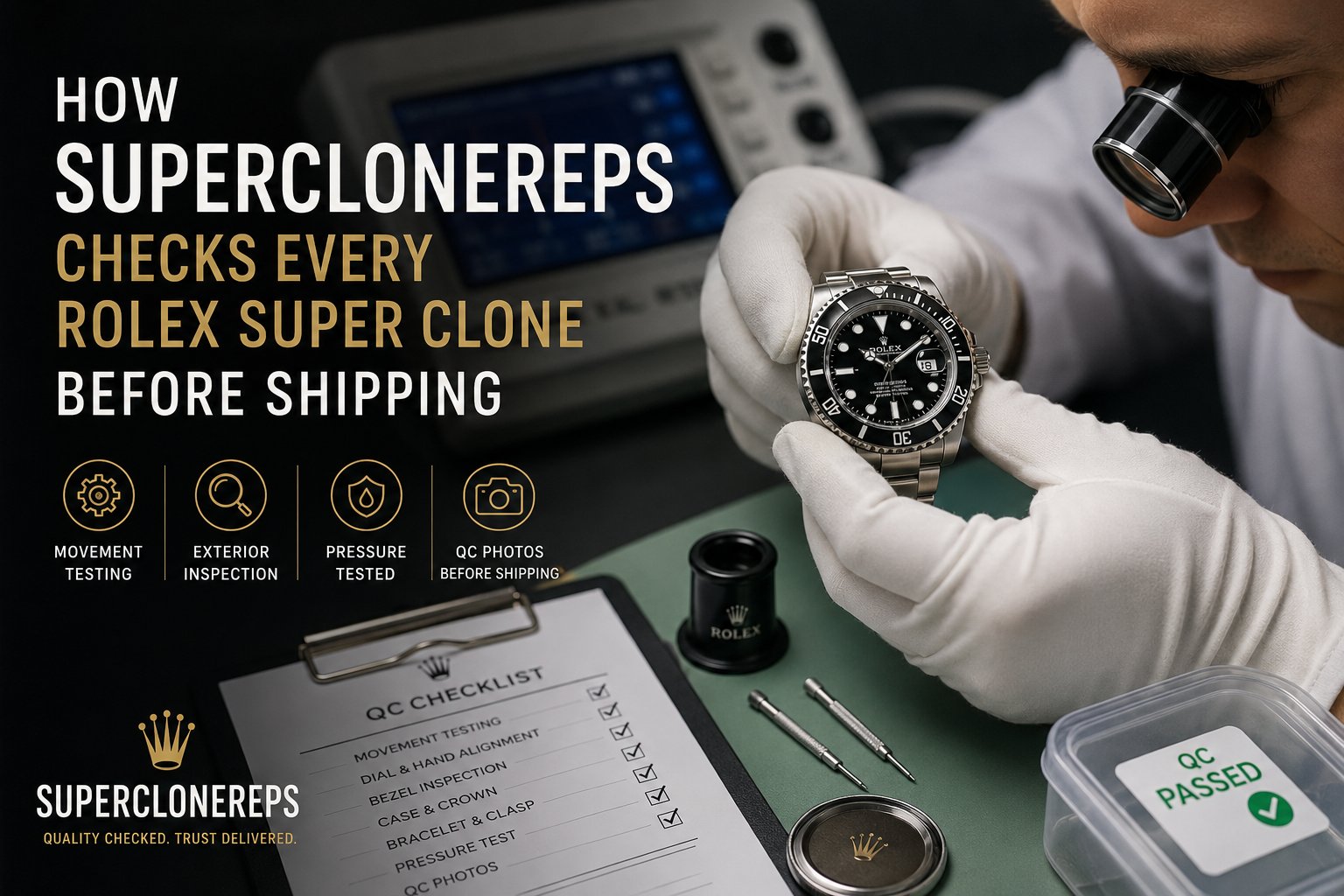
Our inspection covers four areas:
- Movement operation and timing behavior
- Dial, hand, case, and bracelet condition
- Pressure or water-resistance testing where the watch is set up for it
- QC photos of the exact watch you’re getting
And one more thing. This is not Rolex authentication. These watches are replicas. The goal is simpler: confirm you’re receiving the right configuration, verify condition and function, and flag obvious mechanical or cosmetic issues early.
What Pre-Shipment QC Can’t Assume
Even watches from the same supplier and production run aren’t always identical. One piece can have better date placement than another. Another can have cleaner bezel alignment at twelve.
Bracelets vary too. Some arrive with every screw seated properly. Others need attention. On chrono models, you might find everything works except the seconds hand reset, which returns a fraction off.
Factory reputation is useful, sure. It tells you what you’re likely to get in a general sense. It doesn’t guarantee that the individual watch in your order matches the best-looking copy you saw online.
That’s why we check the allocated watch, not just stock photos or a factory sample image.
Step-by-Step: Confirming You Got the Right Watch
Start with something basic. Then move to the details.
Before we touch alignment or movement, we verify the watch matches what you ordered. That includes:
- Model family
- Reference style
- Factory
- Case size
- Dial color
- Bezel configuration
- Bracelet type
- Any special configuration requested
It sounds obvious until two near-identical listings sit side by side. A black-dial Submariner Date and a no-date Submariner may look close at a glance, but they’re not interchangeable. The same goes for different GMT-Master II bezel combinations, Datejust bracelet setups, or Daytona dial variants.
Once the configuration checks out, then we inspect how the watch performs and how it looks in real life.
Movement and Timing Inspection (What We Actually Watch)
We begin with normal operation. Then we test the functions that matter for that specific movement.
The crown gets checked in the positions the watch supports. We verify winding behavior, time setting, and date adjustment when the model has a calendar. Hands should move without grinding, binding, or weird contact.
Depending on the model, testing can include starting and maintaining operation, manual winding, crown-position behavior, and adjustments for hours and minutes. Calendar behavior is checked as well—date setting and the date change moment. GMT models get GMT-hand adjustment tests. Chronographs get start, stop, and reset checks.
A Daytona-style chrono isn’t the same job as a Submariner-style watch. Pushers, engagement, and reset function differently, and the checklist has to match that.
What about timing numbers? We’re not claiming lab-grade accuracy. Mechanical watches drift. That’s normal.
We’re watching for unusual behavior. If something feels wrong, we treat it as a problem, not a shrug.
- Stops shortly after winding
- Rate changes dramatically during observation
- Crown feels unusually rough
- Date mechanism fails to engage properly
- GMT hand won’t adjust as expected
- Chronograph hand doesn’t reset correctly
- Excessive rotor noise
- Unclear resistance when adjusting
If the watch shows a significant mechanical issue, it doesn’t move forward. We hold it back rather than sending it out and hoping it’s “close enough.”
Dial, Hand Alignment, and the Date Window
Dial checks need a straight look. Angled photos lie sometimes.
When the camera is off-axis, a marker can look crooked even if it isn’t. Sometimes the opposite happens too—an actual alignment issue gets hidden depending on the direction of the shot. A front-facing view gives the clearest read.
We check marker placement at twelve, three, six, and nine. We review the rest of the hour markers, the coronet placement, and the dial printing. Minute-track consistency matters. We check hand alignment and luminous marker condition. If there’s dust or debris visible, we note it. On date models, we check the date-window positioning too.
We also look at the cyclops placement on date variants. The point isn’t rejection over tiny, microscopic differences. It’s to catch visible issues that would bother you on the wrist.
Date alignment details
Date windows draw attention for a reason. The number should sit reasonably close to the center of the opening rather than pressed toward the top, bottom, or one side.
The cyclops should line up over the date window as well. Since the date wheel changes appearance between single-digit and double-digit numbers, we don’t judge the whole mechanism from one day. If there’s a problem, it shows up more reliably when you look beyond a single date.
Bezel and Crystal: Where Looks Can Drift
Sports models live and die by the bezel. If that’s off, the whole watch face looks off.
For Submariner- and GMT-style watches, we check how the bezel’s visual relationship lines up with the twelve o’clock dial marker. We review the insert and the engraved numerals, the luminous pearl, and the overall condition.
If the bezel rotates, we test the motion. It should move consistently and settle into expected positions. Some models have slight play by design. Excess looseness or irregular behavior suggests a problem.
Crystal inspection is separate and just as important. We look for visible scratches, chips around the edge, distortion, dust beneath the crystal, cyclops alignment, and unusual haze or cloudiness.
Clear or clean crystal quality changes how everything underneath appears. A dial can be well made, but a cloudy or distorted crystal makes the whole watch look worse.
Case, Crown, and Exterior Review
The case gets checked from multiple angles. Front, sides, and back all matter.
At this stage, we’re looking for issues that could have appeared during manufacturing, handling, or transport before the watch reached us.
Exterior review includes case finishing, lug condition, crown operation, crown-guard symmetry, and caseback condition. Chronograph pushers get their own look. Engravings are checked. We also note visible scratches and—where relevant—plating or wrapping consistency.
For screw-down crowns, the crown should screw down and release normally. It shouldn’t feel cross-threaded or require excessive force.
Chronograph pushers should engage the functions properly without sticking and without feeling unusually loose.
Bracelet and Clasp QC (The Part You Use Every Day)
Bracelets reveal quality fast. Dials get the attention in photos, but you live with the bracelet and clasp.
We check link articulation and end-link fit. Screw condition matters. We review bracelet alignment. Clasp closure gets tested. We inspect the adjustment mechanism, including whether anything feels unfinished or sharp.
Looseness is a big one. We look for excessive play and visible scratches too.
The clasp should close securely and release the way it’s designed to. Links should articulate normally without grinding against each other. On adjustable clasps with an extension or micro-adjustment system, we verify that mechanism where practical.
A feature isn’t useful if it jams the first time you try to resize it.
Pressure Testing and Water-Resistance Limits
Water resistance is where wording matters. A replica inspired by a dive model shouldn’t be treated as automatically safe for swimming just because the original brand made a water-rated version.
Actual sealing performance depends on the individual watch assembly: crown, crystal, caseback, gaskets, and seals.
When pressure testing is included for a given watch, we test the specific piece using the appropriate method before shipment. The purpose is to identify an obvious sealing problem at the time of testing.
It isn’t a claim that the replica passed the same kind of factory testing as a genuine Rolex, and it isn’t a substitute for professional dive-watch certification.
Even with a successful pre-shipment check, common-sense precautions still matter. Gaskets age. A crown can be left unscrewed. A watch can be opened for adjustment or servicing later.
If you plan regular swimming or significant water exposure, arrange a pressure test locally after you receive the watch.
QC Photos: Seeing the Actual Watch, Not a Guess
Once the physical checks are done, QC photos go out for your order.
Depending on the model, the images may include a straight dial view and an angled dial view, left-side and crown-side case shots, the caseback, bracelet, clasp, and close-ups of the date and bezel. When relevant and available, we include a movement view too.
The big point is that these photos show the exact watch allocated to your order. You’re not approving a factory sample photographed months earlier.
We also pay attention to perspective. Extreme macro shots can exaggerate tiny tolerances. Too-wide shots can hide real issues. The aim is a realistic view before dispatch.
Final Decision: Ship or Replace
A watch doesn’t get approved just because it came from a known supplier or factory. Checks come first.
If we find a minor issue that can be corrected before shipping, we address it. A significant mechanical, alignment, bracelet, exterior, or sealing problem means the watch is rejected rather than sent out.
Then we source another example from the supplier. That replacement runs through the same inspection steps. If it also fails, it’s rejected too.
This can add time. Still, fixing the problem before international shipping is easier than dealing with it after the watch arrives.
What You Receive Before Shipment
You get QC photos of the actual watch allocated to your order before it leaves.
Those images let you review the visible details—dial, bezel, case, bracelet, clasp, and date alignment where applicable.
Depending on the watch and the checks done, you may also see movement testing notes and pressure-test information.
If you spot a reasonable QC concern after reviewing the photos, we re-check it before shipping. Confirmed issues that don’t meet our QC standards lead to rejection and another replacement being sourced. That replacement goes through the same QC steps before you see it.
The whole point is simple. You should have a chance to see what you’re actually getting, instead of discovering a problem only after opening the package.
What This QC Process Does Not Claim
This QC process is about confirming condition, operation, configuration, and inspection status. It’s not genuine Rolex authentication.
Super clone watches are replicas. Terms like “super clone,” “1:1,” and “clone movement” are used in the replica-watch market, but they aren’t Rolex categories and they aren’t independent regulated quality standards.
QC also doesn’t mean you’ll never need maintenance. Automatic movements eventually need regulation, cleaning, lubrication, or repair. Impacts during transport or everyday wear can affect performance after inspection. Water resistance can shift as seals age.
QC reduces avoidable problems and flags obvious issues before shipment. That’s the practical value.
Frequently Asked Questions
Does SuperCloneReps authenticate Rolex watches?
No. We inspect Rolex super clone watches for condition, operation, configuration, and visible QC issues. This isn’t authentication of genuine Rolex models.
Authenticating a genuine Rolex would require determining whether the watch and components were manufactured or approved by Rolex. That’s not what our QC covers.
How long does the inspection take?
It depends on the model and how the movement and checks play out. Availability also matters, especially if the first piece is rejected and a replacement needs to be sourced.
What happens if a watch fails inspection?
It doesn’t ship. If we find a significant movement, alignment, exterior, bracelet, or pressure-related issue, we reject it and order another example.
That replacement goes through the same inspection steps. We keep sourcing until we get a piece that meets our QC standards and is suitable to show you.
Do all buyers receive QC photographs?
Yes. Photos are provided before shipment, showing the actual watch allocated to your order rather than only a generic or factory photo.
Does pressure testing mean the watch is safe for swimming?
Not necessarily. Pressure testing checks sealing at the time of the test, but it doesn’t guarantee lifetime water resistance.
Gaskets and seals change over time, and opening the watch for adjustments can also affect water resistance. If you plan regular swimming or heavy water exposure, get it tested locally after it arrives.
Is every watch from a well-known factory automatically approved?
No. Factory reputation may help when comparing general construction and expected accuracy across models, but each individual watch still needs to be checked.
Batch variation, assembly differences, handling, and transport can all affect a single watch.
Can a buyer reject a watch after seeing QC photos?
Yes. If you spot a reasonable QC concern in the photos before shipment, we review it again.
If the concern is confirmed and the watch doesn’t meet our QC standards, we reject that piece and source another one. The replacement has to pass QC as well before it’s presented.
Final Thoughts: Listings Tell You the Plan, QC Tells You the Reality
A product title and a factory name describe what the watch is supposed to be. They don’t tell you what condition the individual piece inside the package will be in.
That’s why pre-shipment quality control matters for this kind of purchase. We check movement operation and timing behavior, dial and bezel alignment, case condition, bracelet function, pressure-test status where applicable, and overall configuration.
Then QC photos give you a chance to look at the actual watch before it ships.
No inspection makes a replica into a genuine Rolex. No mechanical watch can be promised to run forever without maintenance. What QC can do is practical: catch obvious issues early, verify the specific watch rather than guessing from photos, and give you a clearer view of what’s leaving the supplier.